

As an Amazon Associate I earn from qualifying purchases at no extra cost to you.
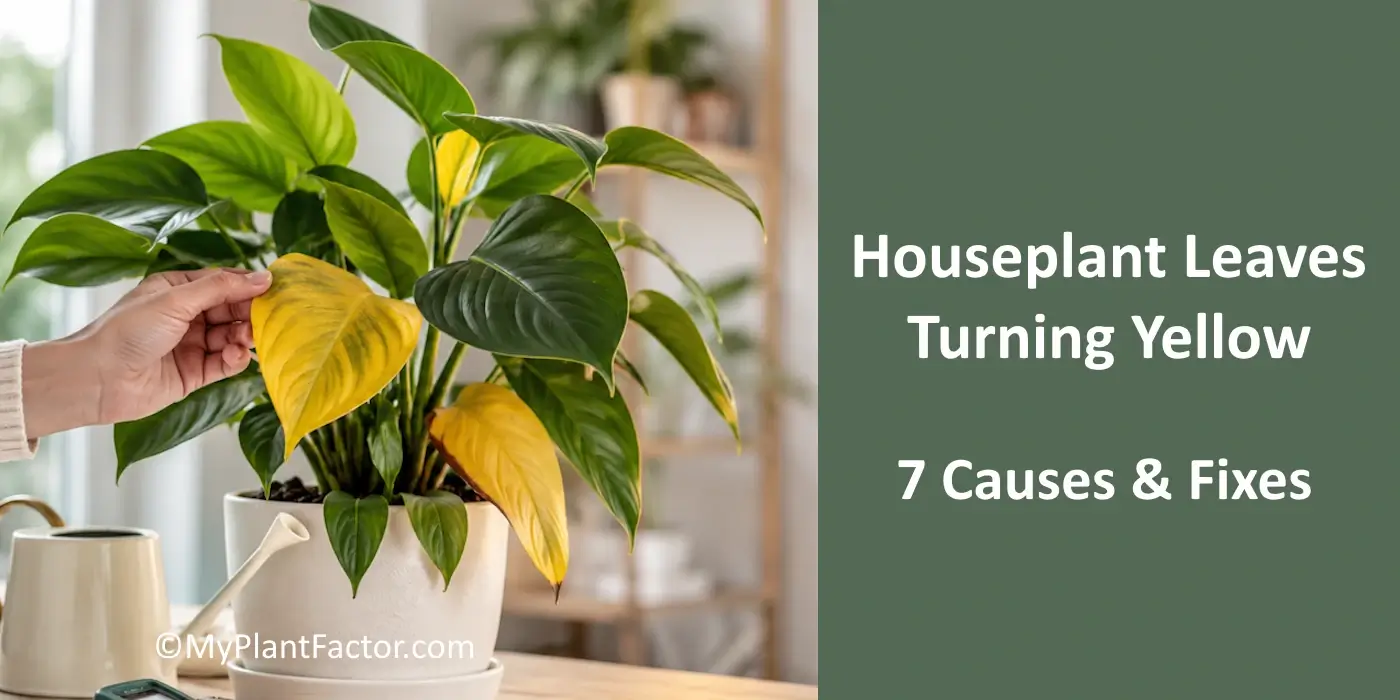
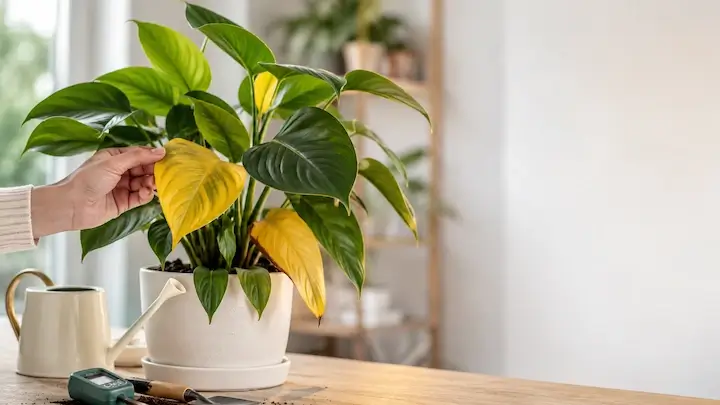
Houseplant leaves turn yellow—a condition called chlorosis—when something disrupts the plant’s chlorophyll production. The seven most common causes are overwatering, underwatering, low light, nutrient deficiency, pests or disease, environmental stress, and natural leaf aging.
Yellow leaves are annoying because they look dramatic, but they’re usually not mysterious. Start with the soil, then check the pattern. The plant is giving you clues. Not poetry. Clues.
The free Plant Doctor diagnoses your houseplant in under a minute — no sign-up needed.
How can you tell why indoor plants are turning yellow? Here’s the fastest way to narrow it down: check whether the soil is wet or dry, then look at which leaves are affected—lower and older leaves, new growth at the top, or the whole plant uniformly.
The good news is that most yellow-leaf problems are fixable. Overwatering is by far the most common cause, and there’s a simple fix—adjust your watering habits alone.
This guide works through each cause in diagnostic order—start with the triage section below to find your answer without reading the whole thing.
Table of contents
- How to Diagnose Yellow Leaves — Start Here
- Overwatering — The Most Common Cause
- Underwatering
- Too Little or Too Much Light
- Nutrient Deficiency — Reading the Pattern
- Pests and Disease
- Temperature, Humidity, and Environmental Stress
- Natural Aging, Root-Bound, and Post-Repot Stress
- Yellow Leaves on Specific Houseplants
- Can Yellow Leaves Turn Green Again?
- When Indoor Plant Leaves Turning Yellow Isn’t a Problem
- Frequently Asked Questions
How to Diagnose Yellow Leaves — Start Here
Before assigning a cause, run through two quick checks. Between them, they eliminate most possibilities in under two minutes.
Step 1 — Check the soil
Pick up the pot and feel the top inch of soil. This single step confirms or rules out the two most common causes.
| Soil condition | Where to go |
|---|---|
| Wet, soggy, or smells musty | Start with the overwatering section. |
| Bone dry or pulling away from the pot edges | Start with the underwatering section. |
| Moist but not soggy | Check which leaves are yellowing next. |
Step 2 — Which leaves are yellowing?
| Where the yellowing appears | Most likely cause |
|---|---|
| Lower or oldest leaves only, one or two at a time | Natural aging or possible nitrogen deficiency |
| New growth at the top | Iron or sulfur deficiency |
| Whole plant looks pale | Low light or environmental stress |
| Patchy, spotty, stippled, or with webbing | Pests or disease |
| One side of the plant only | Draft, heating vent, or direct sun hitting one side |
| After moving, repotting, or buying the plant | Acclimation or post-repot stress |
The sections below work like a troubleshooting map. Find the closest match and start there. Guessing is where plant care gets expensive.
Overwatering — The Most Common Cause

I always check overwatering first because it’s boring and usually guilty. The top of the soil can look innocent while the lower half of the pot is still sitting there like a wet sponge.
If the soil feels wet or waterlogged and the pot is heavier than expected, overwatering is the most likely explanation. It accounts for the majority of yellow-leaf reports across plant forums, and it’s easy to do — most houseplants need far less water than people assume.
What overwatered yellow leaves look like
- Uniform pale yellow, typically starting on lower or older leaves first
- Texture is soft and slightly limp — not dry, not crispy
- Soil may smell musty or faintly sour
- Stem base may feel soft or appear slightly dark
- Fungus gnats hovering around the soil are a strong secondary signal — they breed in consistently wet conditions
This pattern shows up most often in peace lilies and monsteras, both of which are frequently overwatered. They’ll yellow from soggy roots before showing any other visible distress.
How to fix overwatered yellowing
Let the top 1–2 inches of soil dry out completely before watering again. Check drainage holes and clear any blockage — standing water in the root zone is what causes the damage.
If the pot has been wet for more than a week or two, check the roots. Gently slide the plant out: healthy roots are white to tan and firm; rotting roots are brown or black, mushy, and smell bad.
If root rot is present: trim the dead roots with sterilized scissors, let the root ball air-dry for a few hours, then repot in fresh, well-draining potting mix. A drainage pot with clear holes will prevent the problem from recurring.
Horticulture experts all agree that fungi that cause root rot in houseplants reproduce best in soggy soil. And yellowing leaves are one of the classic signs that roots are starting to rot, and the plant needs to be repotted.
This guide on the best soil for indoor plants helps you determine the best potting mix for your plants.
Going forward, a moisture meter tells you exactly when soil is dry enough to water, which varies by pot size, season, and plant type, and can’t be reliably guessed by eye. You can check out the best moisture meters to ensure you only water houseplants when necessary.
Underwatering
Underwatered plants usually look crispier and more dramatic. Overwatered plants slump. Underwatered plants wrinkle, curl, and make the pot feel suspiciously light when you pick it up.
Plants that need more water look different from overwatered plants in almost every way — the soil, the pot weight, and the leaf texture all point in the opposite direction. It’s also easier to fix.
What underwatered yellow leaves look like
- Dry, papery texture — edges often brown and curl before or alongside the yellowing
- Soil visibly dry and possibly cracked or pulling away from the pot’s inner wall
- Pot feels noticeably light when lifted
- Plant may be drooping or wilting overall, not just yellowing
Overwatering vs. underwatering — comparison table
| Signal | Overwatered | Underwatered |
|---|---|---|
| Leaf texture | Soft, limp, or slightly mushy | Dry, crispy, or papery |
| Soil feel | Soggy, wet, or musty | Bone dry, cracked, or pulling from the pot |
| Pot weight | Noticeably heavy | Very light |
| Stem base | Soft or dark near the soil line | Usually firm |
| Leaf color | Pale, uniform yellow | Yellow with browning tips or edges |
| Yellowing pattern | Often starts on lower leaves | Lower leaves plus overall drooping |
How to fix underwatered yellowing plant leaves
Water thoroughly — until water drains freely from the drainage holes. Don’t stop at the surface.
If the soil has become hydrophobic (water runs straight through without absorbing), bottom-water instead: set the pot in a basin with 2–3 inches of water and leave it for 20–30 minutes. The soil draws moisture up from the bottom and rehydrates more evenly.
Going forward, don’t rely on a fixed watering schedule. Check the top 1–2 inches of soil before every watering. When it’s dry, water. When it’s still moist, wait. The right interval varies too much by plant, pot size, and season to set a single timer and trust it.
Too Little (or Too Much) Light
Light-related yellowing usually creeps in slowly. The whole plant starts looking tired, not just one dramatic leaf turning yellow on its own. It’s easy to mistake the problem for something else.
In my experience, low light sneaks up on you. The plant doesn’t collapse overnight. It just gets paler, slower, and a bit sad-looking, which is exactly how I look by February.
Signs of too little light
- Gradual yellowing across all leaves — not concentrated on lower ones
- Plant is leggy or leaning visibly toward the window
- New leaves emerging noticeably smaller than the older ones
- Yellowing is often worse on the side facing away from the light source
Most houseplants need bright indirect light to maintain their color. If a plant is sitting more than 6–8 feet from a window, or in a north-facing room with limited natural light, low light is a real possibility. ZZ plants and snake plants tolerate dim conditions better than most; monsteras and fiddle leaf figs will pale out quickly without adequate brightness.
Signs of too much direct sun
- Yellow or bleached patches on the light-facing side — not uniform across the whole leaf
- Crispy brown edges or scorch marks alongside the yellow
- Most common when a shade-grown plant is moved suddenly into direct sun
Fix
For low light: move the plant closer to a window, or add a full-spectrum LED grow light positioned 12–18 inches from the plant, running 12–14 hours per day.
For too much direct sun: a sheer curtain on a south- or west-facing window filters the intensity without blocking the light entirely. East-facing windows are the most forgiving indoor light for most tropical houseplants — bright in the morning, indirect the rest of the day.
One thing worth noting: overwatering and low light compound each other. Soil dries out much more slowly in dim conditions, which means the threshold for overwatering drops significantly for plants in darker spots.
Nutrient Deficiency — Reading the Pattern
Chlorosis can be caused by nutrient problems even when the minerals are technically present in the soil. If the pH is off, roots are damaged, or the growing medium is exhausted, plants can’t access what they need. The key diagnostic tool: which leaves are affected and what pattern the yellowing follows.
Nitrogen deficiency (most common)
- Older, lower leaves turn uniformly pale green, then yellow
- Yellowing starts at the base of the leaf and moves outward
- Leaves feel firm and dry — mushy or limp points to overwatering, not deficiency
- Fix: balanced liquid fertilizer at half strength, monthly during the growing season
Iron deficiency (interveinal chlorosis)
- The tissue between leaf veins turns yellow while the veins themselves stay green — a distinct skeleton or net-like pattern
- Affects newer, younger leaves first; iron is relatively immobile in the plant, so new growth can’t access what’s stored in older tissue
- Fix: chelated iron spray applied directly to the leaves
Magnesium deficiency
- Interveinal yellowing similar to iron, but affects older leaves first
- Yellow patches between veins; edges stay green until later in the process
- Fix: Epsom salt solution (1 tsp per liter of water) applied as a foliar spray, monthly
Potassium deficiency
- Yellow and brown margins on older leaves; inner leaf stays green for longer
- Fix: balanced fertilizer with adequate potassium content
Overfertilizing — when too much feed causes yellowing
- Yellow-brown crispy tips rather than full-leaf yellowing
- White salt crust may appear on the soil surface
- Fix: flush the soil thoroughly with plain water; stop fertilizing for 4–6 weeks
Nutrient deficiency comparison table
| Deficiency | Which leaves yellow first? | Visual pattern | Fix |
|---|---|---|---|
| Nitrogen | Older, lower leaves | Uniform pale yellow | Use a balanced liquid fertilizer during the growing season. |
| Iron | Newer, upper leaves | Yellow tissue between green veins | Use chelated iron if the pattern clearly matches. |
| Magnesium | Older leaves | Yellow patches between veins | Use an Epsom salt solution cautiously and avoid overdoing it. |
| Potassium | Older leaves | Yellow or brown margins with greener centers | Use a balanced fertilizer with adequate potassium. |
| Sulfur | Newest growth | Uniform pale yellow on young leaves | Use a balanced fertilizer and check soil health. |
Act faster if you see mushy stems, black roots, sticky residue, fine webbing, or rapid leaf drop. Those signs usually point to root rot, pests, or disease, not normal aging. One yellow lower leaf is plant housekeeping. A whole plant going pale is a different conversation.
Pests and Disease
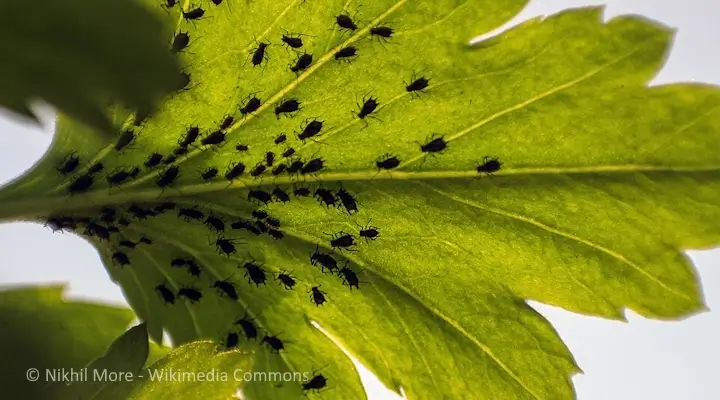
If soil moisture and light are both fine and the yellowing is patchy, spotty, or irregular, check the undersides of leaves before diagnosing anything else. Take the plant into good light and look carefully — some pests are small enough to miss under standard indoor lighting.
Before blaming fertilizer, flip the leaves over. Pest damage loves the undersides, leaf joints, and all the awkward little places you don’t check until things already look weird.
Common pest culprits and their signatures
- Spider mites: tiny yellow or white stippling dots across the leaf surface; fine webbing on leaf undersides; thrive in warm, dry indoor air
- Aphids: clustered on new growth; leaves curl and yellow; sticky honeydew residue on leaves and surfaces below the plant
- Mealybugs: white cottony masses at leaf joints and stem crevices; widespread soft yellowing and drooping
- Scale: brown waxy bumps on stems; causes similar slow-drain yellowing to mealybugs; easy to miss because they don’t move
- Thrips: silvery or bronze streaking alongside yellowing; harder to spot; more common in dry conditions
If you’re worried about pests affecting your houseplants, my article about tiny black bugs in potting soil can help diagnose trickier problems with infestations.
This kind of patchy, uneven yellowing shows up most often in plants with dense or waxy foliage — hoyas, peace lilies, and anything with textured leaves where pests can shelter.
Leaf spot disease
Yellow halos around brown spots typically signal bacterial or fungal leaf spot disease. It’s usually triggered by a combination of overwatering, poor air circulation, and wet foliage from overhead watering.
Fix: remove affected leaves with clean scissors, improve airflow around the plant, and apply a copper fungicide as a preventative. Avoid misting directly onto leaves if airflow in the room is poor.
Treatment for pests
- Isolate the plant immediately — most indoor pests spread to neighboring plants quickly
- Wipe leaves physically with a damp cloth to remove live pests and eggs
- Spray with a neem oil solution (neem oil + water + a drop of dish soap) every 5–7 days for three weeks. Here are the top neem oil sprays for houseplants that are worth using.
- Inspect new plants before bringing them home — this is where most infestations enter the house
If you’re new to caring for indoor plants, my helpful guide to using neem oil for natural pest control can help you look after your plants and keep them bug-free.
Temperature, Humidity, and Environmental Stress
Sudden yellowing that doesn’t fit the soil or leaf-pattern diagnostic often has an environmental cause. Most tropical houseplants prefer 60–80°F (16–27°C) and 40–60% relative humidity. Outside those ranges, stress yellowing sets in.
Signs: rapid leaf yellowing and drop, a pale or whitish-yellow tone rather than vivid yellow, yellowing concentrated near windows, exterior walls, or heating vents.
Common triggers:
- Cold drafts from windows in winter — especially damaging to pothos, philodendrons, and hoyas. Temperatures below 50°F can cause chilling injury, with fast yellowing and leaf drop
- Hot dry air from heating vents — strips humidity and triggers edge yellowing, particularly on tropical species
- Sudden environmental change — moving a plant to a new room, repotting it, or bringing it home from a store all cause temporary stress that looks like environmental yellowing but usually resolves on its own within 2–4 weeks
Fiddle leaf figs are notorious for dropping leaves when relocated — even a short move to a different corner of the same room can trigger it. This is acclimation, not disease.
Fix:
- Move plants away from drafts, exterior doors, and heating vents
- Group plants together — shared transpiration raises local humidity naturally
- A pebble tray with water under the pot is low-effort; a small humidifier works better for sensitive tropicals
- Aim for temperature stability — fluctuations of more than 10°F in short periods stress most tropical houseplants
Natural Aging, Root-Bound, and Post-Repot Stress
Not every yellow leaf signals a problem. Three situations produce normal yellowing that doesn’t need diagnosing — just recognizing.
Natural leaf aging
Plants shed their oldest, lowest leaves as they grow. This is a continuous, healthy process. Expect one or two lower leaves to yellow and drop periodically on an otherwise actively growing plant.
The signal it’s not normal: yellowing is widespread, affecting new growth at the top as well, or the rate of loss is outpacing new growth.
Plants that shed most visibly: dracaenas, corn plants, pothos (trailing stems), and fiddle leaf figs when they’re moved around too frequently.
Root-bound yellowing
When a plant has outgrown its pot, roots can’t access water and nutrients efficiently even when both are present. The result mimics nutrient deficiency — a slow, progressive yellowing across the plant.
Signs: roots circling visibly at the base of the soil ball, roots poking through drainage holes, or soil that dries out extremely fast after watering.
Fix: repot into a pot 1–2 inches wider with fresh potting mix. Don’t jump to a pot that’s too large — excess soil retains moisture and can trigger overwatering symptoms in a plant that doesn’t need the extra volume yet.
Post-repot and acclimation stress
A plant moved from a store, freshly repotted, or relocated to a new room may drop or yellow a few lower leaves in the first 2–4 weeks. This is a normal stress response, not a sign that something went wrong.
Fix: stable location, consistent watering, and minimal fussing. Resist the urge to compensate with extra water or fertilizer. If healthy new growth appears within four weeks, the plant is recovering normally.
Yellow Leaves on Specific Houseplants

Snake plant leaves turning yellow
Snake plants (Dracaena trifasciata) yellow most commonly from overwatering — they’re adapted to drought and need their soil to dry out completely between waterings. If the yellowing is at the base and the leaf feels mushy, root rot is the likely culprit. Uniform pale yellowing across the whole plant points to low light.
My complete diagnostic article on why a snake plant turns yellow contains a full diagnosis guide specific to sanseverias, with causes, fixes, and prevention tips.
Philodendron leaves turning yellow
Philodendrons most often yellow from overwatering or insufficient light. They’re forgiving plants, but sitting in consistently wet soil will cause lower leaves to pale and drop. Fast growers shed their oldest leaves regularly, so a couple of yellowing lower leaves on an otherwise healthy philodendron is normal. If new leaves are emerging small and pale, check the light first.
Hoya leaves turning yellow
Hoyas are more prone to overwatering yellowing than almost any other common houseplant — their thick, waxy leaves store water and don’t communicate drought stress as clearly as thin-leaved plants do. If a yellowing hoya leaf feels soft rather than firm, overwatering is almost certainly the cause. Check the roots and reduce watering frequency before looking at anything else.
Can Yellow Leaves Turn Green Again?
No. Once a leaf is fully yellow, the chlorophyll is gone, and that leaf will not turn green again. A fully yellow leaf has already clocked out.
There’s one partial exception: if the underlying cause is caught and corrected while yellowing is still mild — just beginning to pale rather than fully yellow — some recovery is possible, particularly with nutrient deficiency.
A fully yellow leaf will not reverse. Remove it with clean scissors at the base of the stem, or a gentle pull if the leaf is ready to release. The plant will redirect that energy to new growth.
What to expect after fixing the problem: the yellow leaves already on the plant won’t recover, regardless of the cause. New growth will emerge green within 2–6 weeks if the fix worked. That new green growth is the signal the plant is recovering — not the existing yellow leaves changing back.
If yellowing continues after addressing the most likely cause, return to the diagnostic table at the top and work through the next branch.
When Indoor Plant Leaves Turning Yellow Isn’t a Problem

Not every yellow leaf is a warning sign. Some houseplants naturally grow yellow, cream, gold, lime, or chartreuse foliage. In those cases, the color is part of the plant’s genetics, not a sign something has gone wrong.
This is common with variegated varieties. Plants like golden pothos, variegated rubber plants, some philodendrons, aglaonemas, and dracaenas can all carry yellow or creamy patterning in healthy leaves. The key is whether the yellow areas look stable, patterned, and firm.
Crotons are the big one. Many croton varieties naturally grow leaves with yellow, orange, red, and green markings. A yellow croton leaf is not automatically sick. Honestly, crotons seem to enjoy looking slightly dramatic even on a good day.
| Yellow leaf pattern | Usually normal? | What to check |
|---|---|---|
| Even yellow, cream, or gold variegation | Yes | Leaf feels firm and the plant is growing normally |
| Yellow mixed with red, orange, or green on crotons | Yes | Color is part of the variety’s normal foliage pattern |
| One or two older lower leaves yellowing | Often yes | Check that new growth still looks healthy |
| Sudden yellowing across many leaves | No | Check soil moisture, roots, light, pests, and temperature |
| Yellow patches with soft texture, brown edges, or leaf drop | No | Treat it as stress, watering trouble, pests, or disease |
Houseplant Leaves Turning Yellow: FAQs
Should I remove yellow leaves from my houseplant?
Yes, remove fully yellow leaves. Once a leaf has turned completely yellow, it will not recover its green color. Snip it at the base with clean scissors, or gently pull it away if it releases easily. Removing dead foliage also improves airflow and lowers the chance of fungal problems.
Can yellow houseplant leaves turn green again?
Fully yellow leaves will not turn green again. The chlorophyll is already gone. A leaf that is only starting to pale may improve if you fix the cause quickly, especially with nutrient issues. Focus on stopping new leaves from yellowing instead of trying to rescue leaves that are already finished.
Why are my plant’s leaves turning yellow and falling off?
Yellow leaves falling off usually mean the plant is under stronger stress. The most common causes are overwatering, root rot, sudden temperature changes, repot stress, or pests. Check the soil first. If it is wet and the stems feel soft, inspect the roots before changing anything else.
Is it normal for lower leaves to turn yellow?
Yes, one or two lower leaves turning yellow can be normal, especially on older growth. Plants shed leaves as they grow. It becomes a problem when several leaves yellow at once, new growth turns pale, or the plant drops leaves faster than it produces fresh ones.
How often should I water my houseplant to prevent yellow leaves?
There is no reliable universal watering schedule. Water when the top 1–2 inches of soil feel dry, then water thoroughly until moisture drains from the bottom. Pot size, light, temperature, soil mix, and season all change how quickly a plant dries out.
What does interveinal chlorosis mean?
Interveinal chlorosis means the tissue between the leaf veins turns yellow while the veins stay green. It often points to iron or magnesium deficiency, depending on which leaves are affected first. New yellow leaves usually suggest iron. Older yellow leaves are more often magnesium.
Why are my houseplant leaves yellow even though the plant looks healthy?
If the plant looks healthy and only one older lower leaf is yellow, it is probably natural aging. No fix is needed. If yellowing spreads, check soil moisture, light level, pests, and recent changes like repotting or moving the plant.
Do yellow leaves always mean overwatering?
No, but overwatering is the first thing to check because it is so common indoors. Yellow leaves can also come from underwatering, low light, pests, nutrient deficiency, temperature stress, root-bound growth, or normal aging. The soil and yellowing pattern tell you which direction to investigate.
