


As an Amazon Associate I earn from qualifying purchases at no extra cost to you.
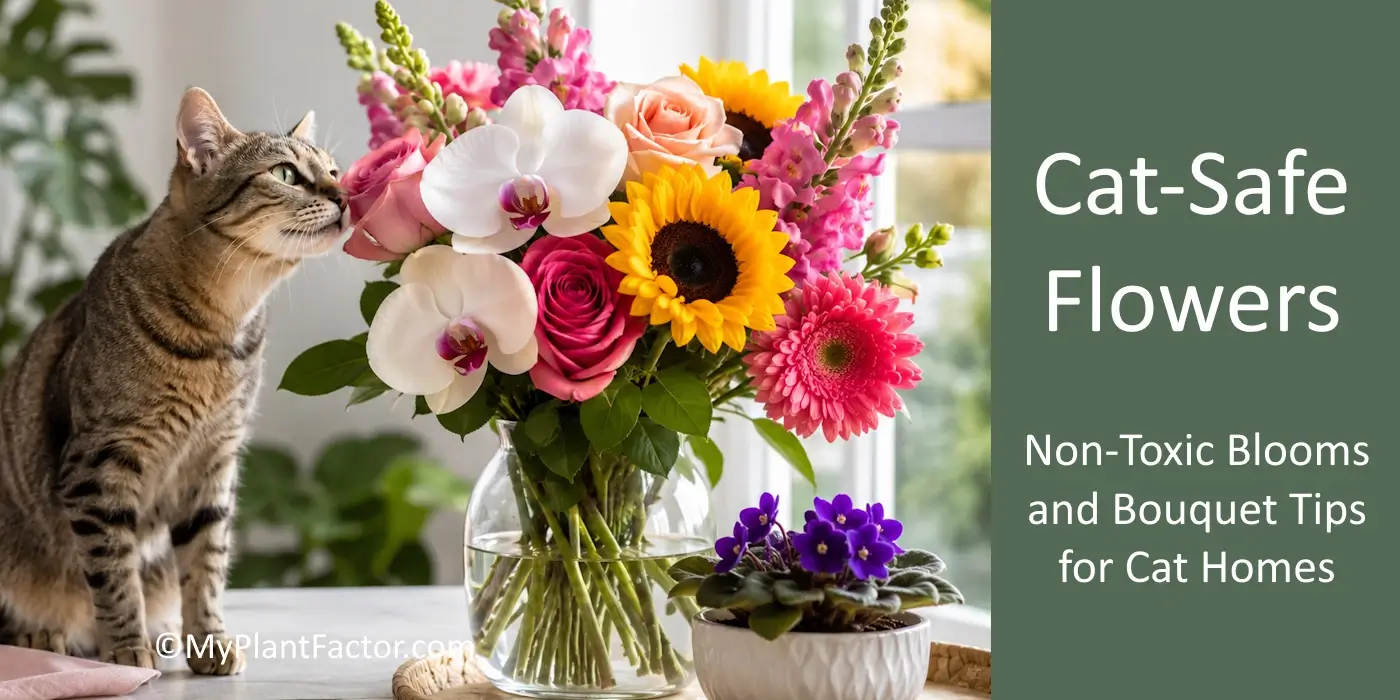
Cat safe flowers are trickier than they look. A bouquet can seem harmless, then hide one risky stem in the filler. The good news is that there are plenty of flowers safe for cats. The safest options include roses, orchids, sunflowers, Gerbera daisies, African violets, snapdragons, freesia, zinnias, statice, lisianthus, asters, waxflower, celosia, blazing star, and Alstroemeria.
These flowers are listed as non-toxic to cats by the ASPCA, though “non-toxic” doesn’t mean snack-friendly. A determined cat can still end up with vomiting or an upset stomach after chewing petals, leaves, or vase water.
The real danger is usually confusion. True lilies, tulips, daffodils, chrysanthemums, carnations, and Baby’s Breath often slip into bouquets, and several are toxic to cats.
This guide focuses on flowers and bouquets specifically. For houseplants — including which common ones are mild versus genuinely dangerous — see the severity-ranked toxic and safe houseplant guide.
So this guide keeps things practical: safe flowers first, risky lookalikes next, then what to tell a florist before any bouquet poses a danger to your furry feline friend.
Table of contents
What “Cat Safe” Actually Means
A cat-safe flower is one that the ASPCA classifies as non-toxic — meaning it doesn’t contain compounds that cause kidney failure, liver damage, or serious systemic poisoning in cats.
That’s not the same as “safe to eat in any quantity.” Even non-toxic flowers can cause vomiting or GI upset if a cat chews through a significant amount. The ASPCA classification reflects acute toxicity risk, not a free pass to let your cat graze.
Two other things worth knowing before you get to the list.
Common names are unreliable. “Peace lily” is toxic. “Peruvian lily” is safe. “Easter lily” is fatal. These all share a word in the name but are completely different plants. When you’re unsure, look up the scientific name (genus and species) and cross-check it on the ASPCA toxic and non-toxic plant list.
Smelling flowers is fine. Cats sniffing a bouquet isn’t a problem. The risk is ingestion — chewing petals, licking pollen off fur, and drinking vase water. More on each of those below
15 Cat Safe Flowers Verified by the ASPCA

Quick-reference table of flowers that won’t hurt cats.
| Flower | Scientific name | Works indoors? | Key note |
|---|---|---|---|
| Rose | Rosa spp. | Yes, as cut flowers | Thorns are the main physical hazard. Watch for pesticide residue on cut stems. |
| Sunflower | Helianthus annuus | Cut flower or garden plant | Seed shells may irritate your cat’s stomach if eaten in quantity. |
| Gerbera daisy | Gerbera jamesonii | Yes, as a potted plant | Chrysanthemums are not safe, even though they can look similar. |
| Orchid | Orchidaceae family | Yes, as a houseplant | Chewing may cause mild stomach upset, but orchids are non-toxic. |
| Snapdragon | Antirrhinum majus | Cut flower or garden plant | A good lily alternative in mixed arrangements. |
| Freesia | Freesia spp. | Cut flower or garden plant | Mild stomach upset is possible if your cat eats a lot. |
| Zinnia | Zinnia elegans | Garden plant or cut flower | Easy to grow from seed and useful for summer bouquets. |
| Statice, or sea lavender | Limonium sinuatum | Cut flower or garden plant | A safer Baby’s Breath substitute for bouquets. |
| Lisianthus | Eustoma grandiflorum | Cut flower | Often mistaken for roses or peonies in arrangements. |
| Asters | Aster spp. | Cut flower or garden plant | Some woody aster types may cause mild upset if eaten in large amounts. |
| African violet | Saintpaulia | Yes, as a houseplant | One of the best flowering indoor plants for homes with cats. |
| Alstroemeria, or Peruvian lily | Alstroemeria aurea | Cut flower or garden plant | Not a true lily. Safe, but stomach upset is possible if eaten in quantity. |
| Waxflower | Chamelaucium uncinatum | Cut flower | A safe filler flower for cat-friendly bouquets. |
| Celosia, or cockscomb | Celosia spp. | Garden plant | Low-maintenance, heat-tolerant, and useful for bold color. |
| Blazing star | Liatris spicata | Garden plant | A native perennial with tall purple flower spikes. |
Roses
Roses are non-toxic to cats — petals, leaves, and stems. The only physical hazard is thorns, which can puncture a cat’s mouth or skin if they chew on a stem. De-thorned cut stems reduce that risk significantly.
One thing worth knowing about cut roses from florists or grocery stores: roses are among the most heavily pesticide-treated cut flowers sold commercially. The flower itself is safe, but chemical residue is a real consideration if your cat regularly rubs against or chews on them. If that’s likely, ask for organic or pesticide-free options.
Roses grown in your own garden without chemical treatments don’t carry the same concern.
Orchids
Orchids (Orchidaceae family) are non-toxic to cats. The most common variety you’ll find as a houseplant — Phalaenopsis, also called moth orchid — is safe. Chewing on leaves or stems may cause mild stomach upset, but nothing dangerous.
Orchids are a solid permanent indoor plant option for cat households. They do well in indirect light with infrequent watering and a bark-based mix. Under the right conditions, they rebloom regularly and can live for years.
Sunflowers
All parts of a sunflower — petals, leaves, stem — are non-toxic. The one thing to watch: if a cat eats a large amount of the rough seed shells once the flower dries and opens, it can cause mild irritation. Keep spent flower heads out of reach once they start dropping seeds.
As cut flowers, sunflowers are a practical choice because they’re large and bold enough that most cats don’t bother trying to eat them.
Gerbera Daisies
Gerbera daisies (Gerbera jamesonii) are non-toxic and a solid option for both cut arrangements and potted plants. They come in a wide range of colors and last well as cut flowers.
The confusion to watch for: chrysanthemums look similar and are toxic. The two plants come up in the same conversations constantly. If you’re buying something labelled just “daisy,” confirm the species before assuming it’s safe. Gerbera daisies specifically — you’re fine.
African Violets
African violets (Saintpaulia) deserve a separate call-out because they’re one of the best flowering indoor plants you can keep in a cat household. Non-toxic, compact, relatively easy to care for, and they bloom almost year-round under the right conditions.
They do well on a bright windowsill with indirect light — direct sun will bleach the leaves. Water from the bottom to avoid crown rot. For a home with cats, they’re a reliable choice because they don’t demand the kind of out-of-reach placement that most flowering plants do.
Are you looking for more pet-friendly purple plants for your indoor garden? My guide to 12 non-toxic cat-safe purple plants has ideas adding color to indoor spaces without putting your furry friend at risk.
Alstroemeria (Peruvian Lily)
Alstroemeria is worth its own entry because of the name confusion. It’s commonly called “Peruvian lily” or “lily of the Incas” and shows up regularly in commercial bouquets — but it is not a true lily and does not cause kidney failure.
That said, it does contain tulipalin A, which can cause vomiting if eaten in larger amounts. It’s not in the same risk category as a rose or sunflower — not dangerous, but not entirely benign if a cat decides to work through a stem. Worth keeping out of easy reach.
Cat Safe Flowers for Bouquets

Buying or receiving a bouquet is where most of the actual risk happens. Grocery store and florist arrangements almost always include filler flowers and greenery you haven’t thought to check — and one very common filler, Baby’s Breath (Gypsophila paniculata), is mildly toxic to cats.
The main flowers in the arrangement might be fine. The filler can undermine the whole thing.
The cat-safe bouquet recipe
These flowers are ASPCA non-toxic and available from most florists:
- Roses
- Sunflowers
- Gerbera daisies
- Orchids
- Snapdragons
- Lisianthus
- Freesia
- Asters
- Statice (use this as the filler — it’s safe)
- Waxflower (another safe filler option)
Safe filler flowers. Statice (Limonium sinuatum) and waxflower (Chamelaucium uncinatum) are both non-toxic and work as direct substitutes for Baby’s Breath in arrangements. Most florists know the swap — it’s a common request from pet owners.
What to tell your florist:
“Please use statice or waxflower instead of Baby’s Breath, and no lilies, tulips, or daffodils.”
That covers the main risks. Say it when you order, not when you pick up.
The cut flower food issue. The small preservative packet that comes with bouquets can cause GI upset even if all the flowers are safe. Cats that drink from vases are the primary route of exposure here. Moving the arrangement out of reach or ditching the packet and using plain water both solve it.
Seasonal availability. Roses are year-round; sunflowers peak in summer; snapdragons are best in spring and fall; freesia is mostly a spring flower. If you’re ordering a cat-safe arrangement for a specific occasion, those windows matter.
Cat-Safe Flowers for Mother’s Day Bouquets
Mother’s Day falls at a good time for this — late April and early May bring some of the most reliably cat-safe flowers into peak availability.
Roses, freesia, snapdragons, alstroemeria, and statice are all in season, all ASPCA-verified non-toxic, and all available from most florists without special ordering. The challenge isn’t finding safe options; it’s knowing which combinations to ask for so you’re not handed a mixed bouquet that sneaks in a lily or a carnation.
One thing to flag: carnations (Dianthus) appear on almost every florist’s spring list and look harmless. The ASPCA lists them as mildly toxic — capable of causing gastrointestinal upset and mild skin irritation if a cat chews the stems or petals. They’re not in the same category as lilies, but they’re worth avoiding if you can substitute easily.
Tell the florist you need a lily-free, carnation-free arrangement and most can accommodate it.
Cat-safe Mother’s Day bouquet combinations to request:
- Classic soft: Roses + freesia + statice + eucalyptus — ask the florist to swap eucalyptus for waxflower, as eucalyptus is toxic to cats
- Bright and full: Gerbera daisies + snapdragons + alstroemeria + statice
- Elegant and simple: Lisianthus + freesia + waxflower — lisianthus holds well in a vase and is widely available from florists in spring
- Garden-style: Roses + snapdragons + sweet William substitute — request Dianthus-free and ask for cornflower or bachelor’s button (both safe) to fill the gap
- All-white or pastel: Alstroemeria + white snapdragons + statice + waxflower — a reliable combination that most florists can build from standard spring stock
When ordering online or from a supermarket, search specifically for “lily-free bouquet” — it’s a recognised filter on most major delivery sites. Then check the full flower list before purchasing.
The First Cat-Safe Flowers of Spring
Most of the flowers that arrive earliest in spring are exactly the ones to avoid around cats. Daffodils, tulips, hyacinths, and lily-of-the-valley are all traditional early-spring bloomers and all toxic — daffodils and hyacinths significantly so. The assumption that spring flowers are cheerful and harmless doesn’t hold up when you look at the ASPCA list.
The safe options do exist, they just tend to be the second wave rather than the first. These are the ones to look for as spring progresses:
Pansies and violas bloom in early to mid-spring, tolerate cold well, and are completely safe. They’re often the first cat-safe colour in a spring garden.
Snapdragons are cool-season annuals that go in early and bloom before summer heat arrives. They’re one of the most reliably safe spring flowers and widely available as transplants from late March onward.
Sweet alyssum is low-growing, honey-scented, and can handle a light frost. It fills gaps in borders and containers and is non-toxic to cats.
Freesia bulbs planted in autumn bloom in early to mid-spring. If you’re planning ahead, these are worth adding — they’re safe, fragrant, and don’t require much attention once established.
Roses are later spring into summer, but some varieties push their first blooms in May. Non-toxic across the board, though thorns are an obvious consideration if your cat investigates closely.
The gap to work around is early spring specifically — February and March, when the toxic bulb flowers dominate garden centres. In that window, pansies in containers are the most practical cat-safe option.
Flowers That Look Safe But Aren’t

The name confusion problem
Several toxic plants share common words with safe ones. This is where most accidents happen — not because the owner didn’t care, but because the name sounded familiar.
| Common name | Scientific name | Safe for cats? | Risk level | Notes |
|---|---|---|---|---|
| Easter lily | Lilium longiflorum | No | Fatal | A true lily. Any part can cause kidney failure in cats. |
| Peruvian lily | Alstroemeria aurea | Yes, with caution | Low | Not a true lily. It may still cause stomach upset if eaten. |
| Peace lily | Spathiphyllum | No | Moderate | Common houseplant, but not safe for cats. |
| Pot marigold | Calendula officinalis | Yes | Very low | Safe, but confirm it is Calendula, not Tagetes. |
| French marigold | Tagetes patula | No | Low | Different genus from Calendula. Can cause mild GI irritation. |
| Daylily | Hemerocallis | No | Fatal | Not a true lily botanically, but equally dangerous for cats. |
True lilies — what makes them different
True lilies (Lilium species — Easter, Tiger, Asiatic, Stargazer) and daylilies (Hemerocallis) are not comparable to anything else on this page. The FDA in the U.S. says that all parts of the plant are toxic: petals, leaves, stems, pollen, and even the water the flowers sit in can kill a cat if ingested.
A cat brushing against a lily and then grooming pollen from its fur is enough to cause poisoning. Kidney failure can begin within hours of ingestion and may not produce obvious symptoms until 12–36 hours later — well past the window where early treatment is most effective.
If you have cats, keeping true lilies out of your home entirely is the standard guidance. There’s no safe placement for them.
Other toxic flowers to know
- Tulips — toxic at all parts, bulbs most concentrated. Cause vomiting, drooling, and lethargy. Common in spring arrangements.
- Daffodils / Narcissus — GI symptoms plus potential cardiac effects in large doses. Very common in spring bouquets and garden borders.
- Baby’s Breath (Gypsophila) — mildly toxic; causes vomiting and diarrhea. In nearly every store-bought bouquet by default.
- Chrysanthemums — toxic; GI upset plus skin irritation. Easy to confuse with Gerbera daisies if you’re not looking closely at the species.
- Carnations — mildly toxic per the ASPCA. Can cause GI upset. Often listed as safe in older sources, but current ASPCA classification puts them in the toxic column.
- Amaryllis — common as a gift plant, especially around winter holidays. Toxic, causes vomiting and lethargy.
- Hyacinths — GI distress, especially the bulbs. Common in spring potted plant arrangements.
Growing Cat Safe Flowers Indoors

Most of the safe flowers on the list above are garden plants or cut flowers. A smaller subset actually works as permanent indoor houseplants — and for a cat household, those are worth knowing specifically. Many of these varieties are available in seed-form and are easy to grow a home.
Best options for indoor growing
African violets are the standout purple plants if you’ve got cats at home. Covered above, but worth repeating: compact, long-blooming, non-toxic, easy to manage. If you want a flowering houseplant you don’t have to think twice about, this is the place to start.
This article lists around 13 pet-safe plants with purple and white flowers.
Phalaenopsis orchids are the other strong option. Non-toxic, genuinely suited to indoor conditions, and they rebloom reliably once you understand their care rhythm. Bright indirect light, water every 7–10 days, let them dry between waterings, bark-based potting mix. They can live for years with minimal fuss.
Gerbera daisies can be grown in pots indoors, though they need good light — a bright south or east window. They’re more commonly used as cut flowers, but a potted Gerbera will last longer and keeps the flower out of reach if placed on a high shelf.
Zinnias are the easiest annual on this list. Direct sow after the last frost, water regularly, and they produce through summer and autumn. They’re non-toxic, drought-tolerant once established, and attract pollinators. If you’ve never grown flowers from seed, start here.
Snapdragons are slightly more work — they prefer to be started indoors 6–8 weeks before the last frost — but they’re forgiving and bloom heavily. Cut them back after the first flush and they usually push a second round.
Cosmos are nearly as effortless as zinnias. Direct sow, thin to about 12 inches apart, and largely leave them alone. They self-seed freely if you let the heads dry out, which means a one-time planting often turns into a recurring patch.
Sunflowers are non-toxic and straightforward from direct seed. The main consideration with cats is the height — tall varieties keep the seed heads out of reach naturally. Shorter patio varieties are fine too, just expect more interest from a curious cat.
The peace lily mistake
Peace lilies (Spathiphyllum) get recommended constantly as easy, low-light houseplants — and they are genuinely easy. But they’re toxic to cats. They cause oral irritation, drooling, and GI symptoms if ingested.
They’re probably the most common “oops” plant in cat households because the name sounds safe, they’re sold everywhere, and they look benign. If you have one, it’s not an emergency to remove it today — but keeping it well out of reach or rehoming it is the practical solution.
Placement basics
Even with non-toxic plants, keeping flowers out of easy reach reduces the chance of GI issues from cats snacking on them. High shelves, hanging planters, or rooms your cat doesn’t have unsupervised access to are all practical options.
This isn’t about risk management for toxic plants — it’s just practical if you’d like your flowers to stay intact. You can learn about some ways to protect your plant in my guide on keeping cats away from plants without wrecking your indoor jungle.
What to Do if Your Cat Eats a Flower
Step 1: Identify the flower
Get the scientific name if you can — common names leave too much room for error. Take a photo if you’re unsure what the plant is. Remove any remaining plant material from your cat’s reach.
Step 2: Call poison control — don’t wait for symptoms
- Pet Poison Helpline: 855-764-7661
- ASPCA Animal Poison Control: 888-426-4435
- Canada BC SPCA: 1-855-622-7722
- United Kingdom RSPCA: 0344 543 1008
- Australia RSPCA: Contact Helpline
Both lines may charge a consultation fee. Call even if your cat seems completely fine. For lilies specifically, kidney damage begins well before symptoms appear — by the time vomiting or lethargy shows up, the window for most effective treatment has already passed.
Step 3: Note what was eaten and how much
Estimate the portion: a few petals, a whole leaf, a stem. Note which part of the plant (pollen exposure is different from ingesting plant tissue). Write down the time it likely happened.
Step 4: Follow their instructions
Depending on what was eaten, they may tell you to monitor at home, bring your cat in, or go directly to an emergency vet. Follow their specific guidance.
One thing not to do: do not induce vomiting at home with hydrogen peroxide. It’s toxic to cats. Only induce vomiting if a vet specifically instructs you to and tells you how.
Cat Safe Flowers: FAQs
Are roses safe for cats?
Yes. Roses are non-toxic to cats, including the petals, leaves, and stems. The main issue is physical injury from thorns. Cut roses may also carry pesticide residue, so keep them out of reach if your cat likes to chew plants.
Are orchids toxic to cats?
No. Orchids are non-toxic to cats. If your cat chews the leaves or stems, mild stomach upset is possible, but orchids are not considered dangerous for cats.
What is the most toxic flower to cats?
True lilies are the most toxic flowers for cats. Easter lilies, Tiger lilies, Asiatic lilies, Stargazer lilies, and daylilies can cause fatal kidney failure. All parts are dangerous, including petals, leaves, pollen, stems, and vase water.
Is Baby’s Breath safe for cats?
No. Baby’s Breath is mildly toxic to cats and can cause vomiting or diarrhea. It is also very common in store-bought bouquets. Ask your florist to use statice or waxflower instead.
Are sunflowers safe for cats?
Yes. Sunflowers are non-toxic to cats. The petals, leaves, and stems are safe from a toxicity standpoint. Seed shells may irritate your cat’s stomach if eaten in quantity, so remove spent flower heads once they dry.
Are African violets safe for cats?
Yes. African violets are non-toxic to cats and are one of the best flowering indoor plants for cat households. They stay compact, bloom well indoors, and do not need dramatic out-of-reach placement.
Are carnations safe for cats?
No, not fully. Carnations are classified as mildly toxic to cats. They can cause vomiting, diarrhea, or mild skin irritation. They are not as dangerous as lilies, but they are not a cat-safe flower.
Are marigolds safe for cats?
It depends on the species. Pot marigold, or Calendula officinalis, is non-toxic to cats. French and African marigolds from the Tagetes genus can cause mild stomach irritation. Check the scientific name before assuming a marigold is safe.
Are daisies safe for cats?
Some daisies are safe, but many are not. Gerbera daisies are non-toxic to cats. Chrysanthemums, chamomile daisies, and showy daisies are toxic. The word “daisy” covers several different plants, so confirm the species before bringing them home.
Are tulips safe for cats?
No. Tulips are toxic to cats. The bulb contains the highest concentration of toxic compounds, but all parts can cause vomiting, drooling, lethargy, and stomach upset.
Are peace lilies safe for cats?
No. Peace lilies are toxic to cats despite the gentle name. They can cause mouth irritation, drooling, vomiting, and digestive upset. They are one of the most common “safe-sounding” houseplants that cat owners accidentally bring home.
