


As an Amazon Associate I earn from qualifying purchases at no extra cost to you.
If you travel often, or you’ve just killed a plant by forgetting it for two weeks, a self-watering pot solves a specific problem: it holds a water reserve the plant draws from on its own schedule, instead of yours.
That’s the appeal. The catch is that not every plant wants consistent moisture, and not every self-watering design is built the same way. A cheap cotton-wick pot behaves very differently from a sealed reservoir system, and the difference shows up in root health, not just convenience.
This guide covers which pots are actually worth buying, which of your plants should go in one, and the root rot question honestly — because the pots don’t cause it the way most people assume.
In this guide:
- How self-watering pots actually work
- Quick picks at a glance
- Best self-watering pots reviewed
- Does this actually cause root rot?
- Which of your plants actually want one
- The real downsides
- Setup and the first two weeks
- Buying guide: what to look for
- If you’re not ready to commit
- Frequently asked questions
How Self-Watering Pots Actually Work
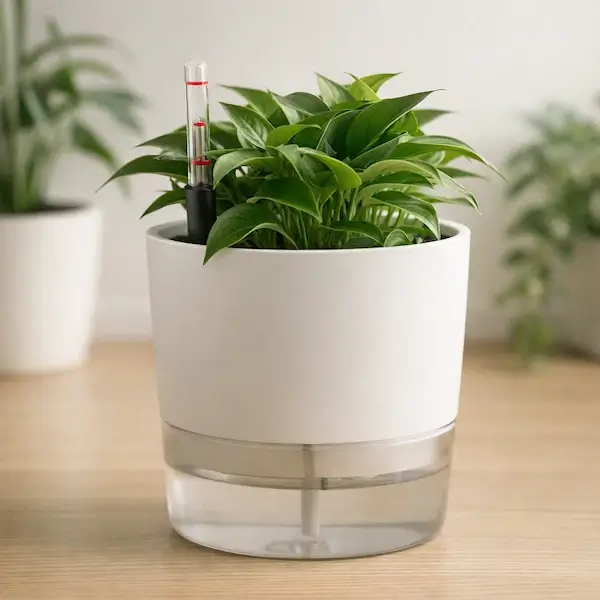
A self-watering pot holds a water reservoir separate from the soil, and pulls moisture upward through either a cotton wick or a sealed capillary channel. The plant draws what it needs instead of receiving a fixed amount on a fixed day. Most models signal refill time with a float gauge or a visible water window, and a full reservoir typically lasts one to three weeks.
Wick-based systems are the cheapest and the most common failure point. The wick keeps drawing water on its own schedule, whether the plant needs it or not. Sealed-reservoir designs let the soil pull moisture only as it dries out, which puts more of the control back with the plant.
This guide to buying the right potting mix for indoor plants helps you match the right type of soil for your houseplants. T
Quick Picks: Best Self-Watering Pots for Indoor Plants
| Product | Type | Best For | Why It Stands Out | Rating | Link |
|---|---|---|---|---|---|
| T4U Self-Watering Planter, Set of 4 | Reservoir | Best Overall | Visible water-level window — no guessing when to refill | ★★★★★ 4.6 | Check Price |
| Vanavazon Self-Watering Pots, 3-Pack | Wick | Best Budget | Lowest cost per pot in this list | ★★★★ 4.5 | Check Price |
| Wavyleaf Self-Watering Pot for LECA and Pon, 4-Pack | Semi-Hydro | Best for LECA/Pon | Clear inner pot makes root and water checks visual | ★★★★ 4.8 | Check Price |
| Lechuza Cubico Color 22 Floor Planter | Reservoir | Best for Large Plants | Genuine 3–4 week reservoir capacity at floor-plant size | ★★★★★ 4.6 | Check Price |
| Mkono Self-Watering Hanging Basket, 2-Pack | Reservoir | Best for Hanging Planters | Fill indicator built into a hanging form factor | ★★★★ 4.7 | Check Price |
| FAMZ Self-Watering Pots, 4-Pack | Wicking planter | Best for Herbs | Cotton wick sized right for small pots most sets get wrong | ★★★★ 4.4 | Check Price |
T4U Self-Watering Planter, Water Level Indicator — Best Overall
A sealed-reservoir plastic pot with a visible water gauge on the side, so refilling isn’t a guessing game. This is the design type that avoids the cotton-wick problem — the soil draws moisture as it dries, not on the wick’s own schedule.
Best For
If you’ve overwatered before and want a visual confirmation before you add more.
What Works Well
- Water-level window removes the single biggest source of self-watering pot mistakes
- Sealed reservoir avoids the constant-draw problem wick systems have
- Sold in a set of four, so one order covers several plants at once
Possible Downsides
- Plastic construction — some owners prefer a heavier, more decorative material
- Reservoir capacity is modest at this pot size; larger plants will drain it faster than the picture suggests
Why It Works for Indoor Plants
The visible indicator matters more than it sounds. Most self-watering mistakes come from either forgetting to check the reservoir or assuming it’s still full. A pot you can glance at removes both problems.
Vanavazon Self-Watering Pots, Wick Rope — Best Budget
A cotton-wick design sold as a 3-pack, priced low enough to test whether self-watering pots suit your routine before committing to a pricier system.
Best For
If you want to try the category on one or two plants before buying anything more expensive.
What Works Well
- Lowest cost per pot of anything in this roundup
- Wick rope is simple to replace once it degrades
- Reasonable size for small-to-medium houseplants
Possible Downsides
- Cotton wicks draw water continuously, which is the exact mechanism behind most self-watering root rot complaints — not a fit for drought-tolerant plants
- No visible water-level indicator, so refill timing is guesswork until you learn the rhythm
Why It Works for Indoor Plants
For moisture-loving plants like pothos or peace lilies, a constant, gentle draw isn’t a problem — it’s closer to what those plants actually want. The wick design becomes a liability specifically when it’s used on the wrong plant.
Wavyleaf Self-Watering Pot for LECA and Pon — Best for Semi-Hydro Growing
This one isn’t for soil. It’s a two-part semi-hydroponic system with a clear inner pot that sits inside a water-reservoir outer shell, built for growers running LECA or Pon instead of traditional mix.
Best For
Anyone already growing in LECA or Pon who wants a reservoir system built for that setup instead of a soil pot retrofitted to work with it.
What Works Well
- Clear inner pot lets you see the water level and root development without unpotting
- Nylon wick draws water up to the medium instead of leaving roots sitting in it
- Water-level indicator on the outer pot removes the guesswork semi-hydro growers usually deal with
Possible Downsides
- Not built for soil — using regular potting mix in this system defeats the design
- Small size (4 inch) means it’s suited to starts and smaller specimens, not mature plants
Why It Works for Indoor Plants
Semi-hydro setups fail most often because growers can’t tell how much water is actually left in the reservoir. A clear pot and a visible indicator fix that directly, which matters more here than in soil-based systems.
Lechuza Cubico Color 22 — Best for Large Floor Plants
A genuine floor-planter size, built for fiddle leaf figs, large pothos, and anything too big for a windowsill pot. The reservoir capacity actually scales with the plant, which smaller sets can’t offer.
Best For
If you own a large floor plant and refilling a small pot’s reservoir every few days isn’t realistic.
What Works Well
- Reservoir genuinely lasts 3–4 weeks at this size, not just on paper
- Sturdy resin construction holds up to a heavier plant and soil load
- Drain plug lets you flush built-up salts occasionally — a detail smaller pots often skip
Possible Downsides
- Premium price relative to the smaller pots on this list
- Large enough that repotting into it is a two-person job for a mature plant
Why It Works for Indoor Plants
Big plants punish small mistakes slowly, which makes consistent moisture more forgiving than it is for a small pot where the reservoir runs out fast.
Mkono Self-Watering Hanging Basket — Best for Hanging Planters
A hanging-basket version of the same reservoir-and-indicator idea, built for trailing plants that dry out fast when they’re up near a ceiling or a warm window.
Best For
If your hanging pothos or string of pearls dries out between waterings faster than you can keep up with.
What Works Well
- Fill indicator built into a hanging design most competitors skip
- Reservoir compensates for the faster drying hanging plants experience from airflow and light exposure
- Chain hook included — no separate hardware to buy
Possible Downsides
- 10-inch size limits which plants fit comfortably — not for anything with a large root ball
- Rattan-style resin finish is decorative, not the most durable material in direct sun long-term
Why It Works for Indoor Plants
Hanging plants dry out faster than potted ones at eye level, simply from more airflow around the pot. A reservoir buys back the margin a normal hanging pot doesn’t give you.
FAMZ Self-Watering Pots, 4-Pack — Best for Herbs and Windowsill Plants
Sized specifically for small plants — African violets, herbs, succulent-adjacent windowsill pots that most self-watering sets size wrong by defaulting to medium or large.
Best For
If you’re growing kitchen herbs or small windowsill plants that most self-watering sets don’t fit.
What Works Well
- Genuinely small-scale, not a medium pot marketed as small
- Set of four covers a full windowsill without buying multiple separate listings
- Cotton wick draws from the bottom reservoir with no proprietary soil or accessory required
Possible Downsides
- Reservoir is correspondingly small — expect more frequent refills than the larger pots on this list
- Basic wick-assisted system, not a sealed reservoir — same caveats apply as the budget pick above
Why It Works for Indoor Plants
Basil and mint want consistent moisture and dry out fast in a small pot. A correctly-sized self-watering system solves exactly that problem without oversizing the container.
Do Self-Watering Pots Actually Cause Root Rot?
Self-watering pots don’t cause root rot by design. Root rot comes from oxygen-starved soil, not from moisture itself, so a well-made pot with proper drainage and the right plant carries no more risk than hand watering. The real triggers are a cotton wick that never lets soil dry, dense non-aerating potting mix, and using the system on a plant that wants to dry out between waterings.
Most advice online treats “self-watering” and “root rot” as if one causes the other. The logic makes some sense on the surface — constant moisture sounds risky. The problem is that the actual cause is oxygen, not water, and the two aren’t the same thing.
Source: Clemson Cooperative Extension guide on how to water infoor plants.
Roots need moisture and airflow at the same time. Compressed, dense soil blocks that airflow even when the moisture level is correct. That’s why the potting mix matters as much as the pot design.
| Cause | Actually the pot’s fault? | Fix |
|---|---|---|
| Dense, compacted potting mix | No — soil choice | Use an aerated mix with perlite or bark, not straight potting soil |
| Cotton wick never lets soil dry | Partly — design choice | Switch to a sealed-reservoir design, or use wick pots only on moisture-loving plants |
| Wrong plant for the system | No — plant selection | Match the plant to the pot type (see the table below) |
| Reservoir overfilled past the indicator line | No — user error | Fill only to the marked line, not past it |
Which of Your Plants Actually Want a Self-Watering Planter?
Pothos, peace lilies, calatheas, ferns, philodendrons, African violets, and spider plants thrive in consistent moisture and are strong self-watering candidates. Snake plants, hoyas, succulents, and cacti prefer drying out fully between waterings, and will struggle or rot in one. Basil, mint, and parsley also do well; rosemary and lavender don’t.
I’ve found that people assume “self-watering” means universally low-maintenance, when it really means consistent-moisture. Those aren’t the same requirement, and mismatching plant to pot is where most of the bad reviews for this whole category come from.
| Plant | Good fit? | Why |
|---|---|---|
| Pothos, philodendron | Yes | Wants consistently moist, not soggy, soil |
| Peace lily | Yes | Wilts fast when dry; consistent moisture suits it |
| African violet, calathea | Yes | Sensitive to drying out between waterings |
| Hoya | No | Epiphytic root system wants to dry out between waterings — see hoya carnosa varieties care guide |
| Snake plant | No | Succulent-adjacent roots rot fast in constant moisture — see snake plant care guide |
| Succulents, cacti | No | Built for drought, not consistent moisture |
| Basil, mint, parsley | Yes | Dries out fast in small pots; benefits from a reserve |
| Rosemary, lavender | No | Mediterranean herbs — want soil to dry between waterings |
The Real Downsides of Self-Watering Plant Pots
Self-watering pots aren’t maintenance-free. Standing water in the reservoir can attract mosquitoes if the pot sits outdoors or in a humid room without a sealed cover, cotton wicks degrade and need replacing every season or two, and overfilling past the indicator line waterlogs soil the same way overwatering by hand does.
The mosquito risk is real but manageable. Standing water becomes a breeding site after roughly a week if it’s exposed to air and warmth. A sealed reservoir with a tight-fitting lid mostly avoids this; an open wick tray in a warm bathroom is where it shows up.
If you want to avoid the risk of bugs breeding in standing water, this guide to houseplant pots can help you decide on which ones best suit your indoor area and plant setup.
Source: EPA guide to how standing water affects mosquito breeding cycles.
Setup and the First Two Weeks
Fill the reservoir fully at setup, water the topsoil normally once to jump-start the wick or capillary watering system, then check the water-level indicator every three to four days until you learn your plant’s actual draw rate.
- Fill the reservoir to the marked line — not above it.
- Water the topsoil by hand once, so the wick or channel starts working immediately instead of waiting on capillary action alone.
- Check the indicator every 3–4 days for the first two weeks.
- Once you know the refill rhythm, most indoor plants settle into a 1–2 week cycle.
Most plants show a visible improvement in leaf firmness within the first week if the system is working correctly. If nothing changes after two weeks, the wick may not be making contact with the soil — reseat it and check again.
Buying Guide: What to Look For in Self-Watering Pot
Reservoir Design
Sealed-reservoir and capillary-mat pots give the plant more control over its own water intake than a plain cotton wick does. Wick pots are cheaper but the wick draws water on its own schedule, not the plant’s.
Water-Level Indicator
A visible gauge removes the single most common mistake in this category — forgetting to check the reservoir, or assuming it’s still full when it isn’t. Pots without one require learning the refill rhythm by trial and error.
Size Relative to the Plant
A reservoir undersized for the plant’s root mass drains faster than the marketing photos suggest. Match pot size to the actual plant, not just the aesthetic you want.
Material
Plastic is lightweight and cheaper; resin and ceramic hold up better to sun exposure and look more finished on a shelf, at a higher price point.
If You’re Not Ready to Commit
A soil moisture meter is the lower-cost first step if you’re unsure whether your plants even need consistent moisture management. It tells you what’s actually happening in the pot before you commit to new planters for your whole collection.
The article reviews the best soil moisture meters for indoor plants to ensure you never overwater your prized houseplants.
Frequently Asked Questions
Do self-watering pots actually work?
Yes, when matched to the right plant and filled correctly. They keep soil consistently moist without daily attention, which suits moisture-loving plants better than it suits drought-tolerant ones.
Do self-watering pots cause root rot?
Not by design. Root rot comes from oxygen-starved soil, not water itself — the real causes are dense potting mix, a constantly-drawing wick, or using the pot on a plant that wants to dry out between waterings.
Can self-watering pots cause mosquitoes?
Standing water can attract mosquitoes after about a week if it’s exposed to warm, humid air. A sealed reservoir with a tight lid mostly avoids this.
Which plants should not go in a self-watering pot?
Snake plants, hoyas, succulents, cacti, rosemary, and lavender all prefer drying out between waterings and are poor candidates.
How often do I need to refill the reservoir?
Most indoor plants settle into a one-to-two-week refill cycle once established, though this depends on plant size, pot size, and room humidity.
Are self-watering pots worth it over a regular pot and saucer?
For moisture-loving plants and for owners who travel or forget waterings, yes. For drought-tolerant plants, a regular pot with well-draining soil is the better match.
Can I convert a regular pot into a self-watering one?
Yes, with a wicking-cord DIY setup, though a purpose-built reservoir pot is more reliable and easier to maintain than a retrofit.
