


As an Amazon Associate I earn from qualifying purchases at no extra cost to you.
If you’re seeing small black flies drift up from the soil, those are fungus gnats. Yellow sticky traps are the fastest way to confirm it. They work by pure visual attraction — no bait, no scent. And they catch far more gnats than any other trap color.
The catch: sticky traps only work for what’s already flying. They are totally ineffective against eggs and larvae, which stay in the soil, and they type of houseplant but that do the real damage. That’s why a sticky yellow trap for gnats “isn’t working” – it’s often doing exactly what it’s built to do. It was never going to fix the whole problem alone.
That’s the problem these tiny black bugs – fungus gnats have a habit of coming back despite your best efforts to get rid of them.
In this guide:
Getting the trap side right still matters. A badly placed or wrong-colored trap catches almost nothing. A well-placed one tells you exactly how bad the infestation is — and when it’s actually clearing.
Why Yellow Specifically Attracts Fungus Gnats
Yellow sticky traps out-catch every other color for fungus gnats. Gnats respond to the color itself — not scent, not bait. Ohio State University entomology research confirms it: yellow traps beat blue, white, green, and red under the same conditions.
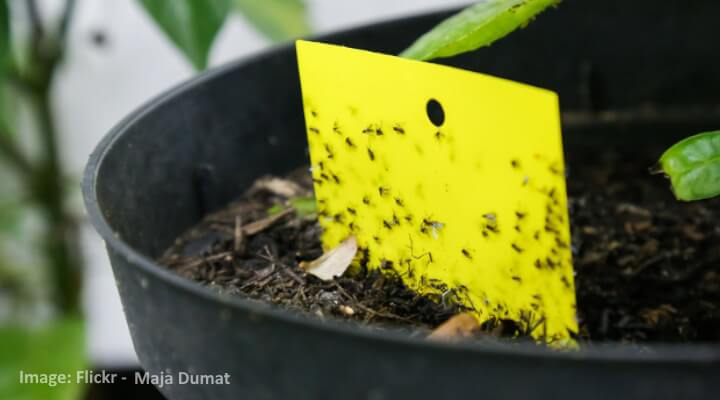
Interestingly, another study found that red sticky traps were more effective at trapping fungus gnats in greenhouses, but that yellow sticky traps were more commercially available.
This is a visual-cue insect, not a scent-tracker. A trap in the wrong color can be placed perfectly and still catch almost nothing. Check color first if a trap seems to be underperforming — before blaming placement or the product.
Yellow Sticky Traps (Flat)
Standard flat yellow sticky traps — lay directly on the soil surface, sticky side up.
What Happens If You Use Blue, Green, or Black Instead {#other-colors}
All yellow traps work about the same. Brand and shape don’t change the attraction. The real differences show up between colors — not between yellow products.
Yellow vs. Blue
Blue traps target thrips, not fungus gnats. Thrips are drawn to blue the way gnats are drawn to yellow. On a gnat problem, blue will catch a few strays — but far fewer than yellow in the same spot.
Blue Sticky Traps
Built for thrips, not fungus gnats — useful if thrips are the actual problem alongside gnats.
Yellow vs. Green
Green doesn’t target any single houseplant pest well. It’s a general-purpose color, not a gnat-specific one. Expect noticeably lower catch numbers than yellow.
Green Sticky Traps
General-purpose color, not gnat-specific — not the right pick for a fungus gnat problem.
Yellow vs. Black
Black traps sell on looks, not performance. They blend in better on a dark pot. That low contrast is exactly why they catch fewer gnats.
Black Sticky Traps
Lower visibility on the shelf, but lower catch rate too — a decor trade-off, not a performance upgrade.
If clearing the infestation is the goal — not matching the pot — yellow is the only color worth buying.
ACV traps are a common fix for fruit flies. Some sources apply the same advice to fungus gnats. But the two pests don’t respond to the same cues. Fruit flies follow scent. Fungus gnats respond mainly to sight. That mismatch likely explains why ACV traps perform inconsistently on gnats — sometimes decent, sometimes almost nothing.
Still worth setting one up alongside a sticky trap. If it catches almost nothing while the sticky trap fills up, that’s a gnat problem, not fruit flies. It’s a fast way to confirm the diagnosis without buying anything.
Homemade ACV trap: mix equal parts vinegar and water in a shallow dish. Add 2-3 drops of dish soap. Set it on the soil surface and replace every 1-2 days. The soap breaks surface tension, so anything that lands sinks instead of flying off.
ACV traps left near a sunny window dry out fast. They stop working within a day.
Why Your Sticky Trap Isn’t Catching Anything
A trap that isn’t catching gnats usually has a color or placement problem — not a defective product. Faded or off-yellow traps lose most of their pull. Traps hung above the foliage miss gnats that stay close to the soil.
Check color first. It needs to be true yellow — not gold, cream, or yellow-green. Then check placement. A trap flat on the soil, or staked into the mix, beats one clipped to a stem or hung above the pot. Gnats are lazy fliers. They stay low.
A trap that’s weeks old and still empty, on a plant with a confirmed infestation, points to one of those two problems. It’s not a sign that sticky traps don’t work. I’ve found that off-yellow traps get blamed for a placement problem that isn’t actually there.
This guide to tiny black bugs in potting soil explores five ways to get rid of the pesky insects for good.
How Many Yellow Gnat Traps You Need, and Where to Put Them
One trap per 4-6 pots is enough for a grouped collection. Gnats don’t need a trap on every plant to be monitored and controlled. Adults move freely between nearby pots, looking for moist soil to lay eggs in.
Stake-style traps beat flat ones laid on the surface. The stake holds the sticky surface right at soil level — exactly where gnats emerge and hover. For one heavily infested plant, a stake trap wins over a flat one in the same spot.
Stakes catch noticeably more than flat traps on plants with dense, low foliage. The flat ones just get buried under leaf litter.
Yellow Sticky Trap Stakes
Stake-style traps insert directly into the potting mix, holding the sticky surface right at soil level.
Why Yellow Sticky Traps Alone Won’t Finish the Job
Sticky and ACV traps both remove adult gnats. Neither touches the eggs and larvae in the top two inches of soil. Trap counts drop, then plateau or climb back as the next generation hatches. That plateau means the trap is doing its job on adults — while the soil-level problem keeps going underneath.

Let the top inch of soil dry out fully between waterings. Fungus gnat eggs and larvae can’t survive in dry soil. Traps handle the visible symptom. Dry soil handles the source. Here are some of the best ways to get rid of gnats in houseplants.
You can also try a neem oil solution for pest control to make getting rid of houseplant bugs easier and more effective.
Frequently Asked Questions
Do sticky traps work for fungus gnats?
Yes. Yellow sticky traps reliably catch adult fungus gnats through visual attraction alone. They don’t touch eggs or larvae in the soil. Pair them with a soil-drying routine instead of relying on traps alone.
Why does trap color matter?
Fungus gnats key in on yellow specifically — not scent or bait. University entomology testing confirms yellow traps out-catch blue, green, black, and other colors for both fungus gnats and whiteflies.
How many traps do I need per plant?
One trap per 4–6 pots is usually enough in a grouped collection. You don’t need a trap on every single plant to monitor and control an infestation.
Why isn’t my sticky trap catching anything?
Check color first — it needs to be true yellow, not gold or cream. Then check placement. Traps at soil level catch more than traps hung above the foliage, since gnats stay close to the soil.
Do vinegar or wine traps work for fungus gnats?
Results are inconsistent. ACV traps work reliably for fruit flies, which respond to scent. Fungus gnats respond mainly to sight — likely why vinegar traps catch them less consistently than sticky traps do.
How often should I replace a sticky trap?
Replace a trap once it’s 30–50% covered, or every 2–4 weeks even if it isn’t full. The adhesive weakens over time regardless of visible coverage.
