



As an Amazon Associate I earn from qualifying purchases at no extra cost to you.
If you’re searching for a grow light for hoya, you’ve probably already noticed the plant isn’t behaving like your other houseplants. It’s not dying under normal indoor light. It’s just not blooming, and the growth between leaves looks stretched instead of compact.
That’s not a coincidence. Hoyas are semi-succulent epiphytes — they grow on trees in dappled, broken light, not the deep shade a pothos or a ZZ plant tolerates without complaint. Most “bright indirect light” advice is written for the wrong category of plant.
Getting a hoya to bloom under artificial light comes down to three numbers most articles skip: wattage, hanging distance, and daily hours. Here’s what actually works, and why the plant responds to light the way it does.
In this guide
How Much Light Does a Hoya Actually Need to Bloom?
Hoya foliage survives on low-to-moderate light, but blooming needs meaningfully more. A full-spectrum LED rated 20-45 watts, positioned to deliver roughly 150-400 µmol/m²/s of PPFD at leaf level, is the range growers consistently report actually triggering flowers indoors — not just keeping the plant alive.
That gap between “surviving” and “blooming” is where most hoya owners get stuck. A hoya can sit in a north-facing room for years, hold its leaves, add the occasional new vine, and never once produce a peduncle. Nothing about that looks unhealthy. It just isn’t getting the light that flowering requires.
Foliage-survival vs. bloom-triggering light
| Tier | What it does | Typical setup |
|---|---|---|
| Maintenance | Keeps the plant alive with slow growth, but no reliable flowering. | Low-wattage LED or bright window, with no dedicated fixture. |
| Active growth / bloom-push | Supports vigorous new growth and meaningfully improves the odds of blooming. | 20–45W full-spectrum LED providing 150–400 µmol/m²/s at canopy level. |
Wattage alone is a rough proxy — it tells you how much power the fixture draws, not how much usable light reaches the plant. Two 30W lights from different manufacturers can put out very different amounts of photosynthetically active light, depending on the diodes and lens design.
If a light meter or PAR meter app is available, use it. If not, wattage plus distance — covered below — gets close enough for a single hoya or small collection.
That covers the hoya-specific numbers. For the broader comparison of LED, fluorescent, and HID grow lights — and which is worth the extra cost for houseplants generally — see the best grow lights main article hub.
One honest caveat: exact PPFD targets specific to hoya flowering haven’t been established in peer-reviewed research. The 150-400 µmol/m²/s range reflects what experienced hoya growers report working, not a lab-verified threshold. Treat it as a strong starting point, not a guarantee.
A PAR meter isn’t required to get this right. Several free phone apps estimate PPFD reasonably well from the camera sensor — not lab-accurate, but close enough to tell “barely lit” from “actually in range.” Point the phone at the light source from where the topmost leaves sit, not from the pot.
PPFD and daily light integral are the units that actually correlate with plant growth — wattage and lux readings don’t translate the same way. Virginia Cooperative Extension’s guide to measuring light covers the math in plain terms.
Why Light Actually Triggers Hoya Blooms
Hoya flowering isn’t a simple “more light equals more flowers” equation — it’s a hormonal response to stable day length. Roughly 12-14 hours of consistent light shifts the plant’s internal hormone balance, and blooms then emerge from permanent, woody peduncles rather than new stems.
This is the piece most grow-light advice leaves out entirely. Photoperiod stability — not just intensity — appears to matter for triggering the hormonal shift behind bud formation. An erratic schedule, even with strong light, can stall a plant that’s otherwise perfectly healthy.
It also explains a common beginner mistake: pruning off what looks like a dead, leafless stub after a hoya finishes blooming. That stub is the peduncle. It persists for years and reflowers from the same point season after season. Cutting it off removes the plant’s fastest route back to blooming.
None of this is dramatic biology — it’s closer to a light switch than a light dial. A hoya either has the conditions to flip that switch, or it doesn’t, regardless of how green and healthy it otherwise looks.
This is also why a hoya can go a full year without blooming after a change that seems minor — a move to a new room, a schedule that shifts with the seasons, a light on a different timer.
The plant isn’t necessarily reacting to less light. It’s reacting to a photoperiod that no longer holds steady long enough to complete the hormonal shift.
Light is only one factor in getting a hoya to flower — humidity, feeding, and a pot-bound root system all play a part too. See the full breakdown in getting a hoya to bloom for the rest of the picture.
Hanging Distance and Daily Duration for Hoyas
Flowering hoyas generally need longer daily light exposure than foliage-only houseplants — 12 to 16 hours under a full-spectrum LED, compared with the 8-10 hours often recommended for shade-tolerant plants. Distance depends on the goal: 12-18 inches above the canopy for maintenance, tightening to 8-12 inches when actively pushing for blooms.
| Goal | LED distance | Daily hours |
|---|---|---|
| Maintenance Keep it alive |
12–18 inches | 8–10 hours |
| Active growth | 10–14 inches | 12–14 hours |
| Bloom push | 8–12 inches | 14–16 hours |
Fluorescent fixtures, including T5 HO tubes some hoya growers still swear by, need more distance than LED at equivalent output — typically 24-36 inches — because they don’t focus light as tightly. A full fixture-type comparison belongs on the broader grow-light guide; the distances above assume LED, which is what most hoya owners are setting up now.
Adjust one variable at a time. Start further away and on the shorter end of the hour range, then step the light closer or extend the timer by an hour every 7-10 days. Watch the newest leaves for bleaching, crisping edges, or a washed-out look — that’s the signal to back off, not push further.
That’s the same adjust-one-variable approach that works for any houseplant under a grow light — the full step-by-step on height, timers, and adjustment schedules covers it in more depth if you want the general version.
A timer removes the guesswork on consistency. Given how much photoperiod stability seems to matter for bloom triggering, a plugged-in timer set to a fixed schedule does more for flowering odds than any single upgrade to the fixture itself.
Not sure a grow light is doing anything at all yet? Here’s the general evidence and realistic timeline for when results actually show up, before you second-guess the hoya-specific numbers above.
Adjusting through the seasons
A hoya near a window still gets natural light shifting with the seasons, even under a supplemental grow light. In winter, extend the timer toward the 16-hour end of the range to offset shorter days.
In summer, if the plant sits near a bright window, the grow light can often drop back toward 12-14 hours without losing ground — ambient daylight is doing more of the work.
Adjust the timer in 30-minute increments rather than swinging the whole schedule at once. The plant responds better to a gradual shift than an abrupt one.
Photoperiod sensing isn’t unique to hoyas — it’s how most flowering plants time reproduction to the season, and it’s been studied since the earliest days of plant science. A recent review of plant photoperiodism covers how this timing mechanism works at the molecular level, if the “why” behind the timer advice is worth digging into.
For the general mechanics of setting up any grow light — height, timers, and adjusting distance as a plant fills out — see how to set up grow lights for indoor plants; the numbers above are the hoya-specific version of that same routine.
Signs Your Hoya’s Light Setup Needs Adjusting
Too little light shows up as stretched growth between leaves, thin new stems, and a hoya that stays healthy-looking but never flowers. Too much light shows up as bleached or crisping leaf edges, sometimes a reddish stress tint on carnosa-type varieties. Both are fixable by adjusting distance or duration — not by replacing the fixture.
Signs of too little light:
- Long gaps between leaves on new growth (stretching)
- New leaves noticeably smaller or thinner than older ones
- No peduncles or flower buds despite otherwise healthy growth
- Vines reaching or leaning toward the nearest window
Signs of too much light:
- Bleached, pale, or washed-out patches on upper leaves
- Crisping or browning at leaf edges nearest the light
- Reddish or purplish tint developing on carnosa-type leaves
- New leaves smaller and more curled than expected
For the full breakdown of why this happens and how to fix it once it’s already occurred, including recovery timelines and which houseplants are most vulnerable, see the dedicated guide.
Move the light before changing anything else. A hoya that’s stretching needs to come closer to the fixture or get more hours. One that’s bleaching needs to move back or run fewer hours.
Neither problem means the plant needs a different light. It means the current setup is wrong for where the plant is right now.
Bleaching and crisping like this is a form of light burn — the same mechanism affects any houseplant under a light that’s too close or running too many hours. The full breakdown of causes and fixes is in can grow lights burn your houseplants.
Grow Light Picks for Medium-High Light Plants Like Hoya
A hoya doesn’t need a specialty “hoya light” — it needs a full-spectrum LED with enough output to hit the range covered above, and a timer that holds a consistent schedule. The three picks below cover a single windowsill plant, a small grouped collection, and a full shelf — pick based on how many hoyas need light, not just one spec sheet.
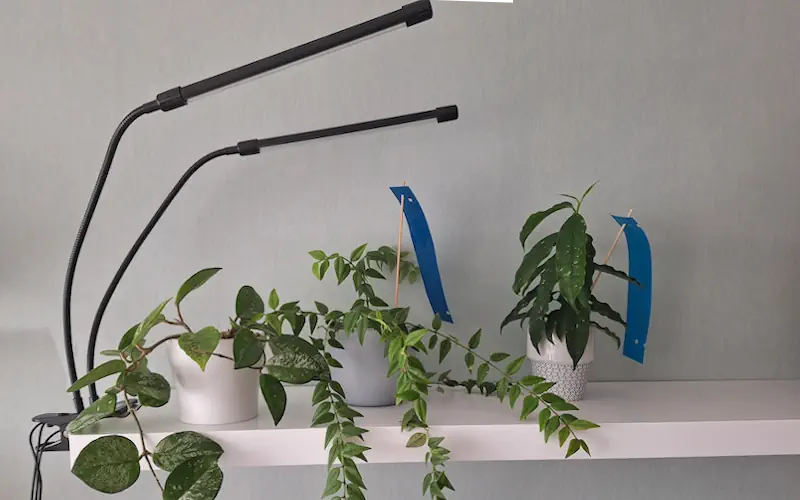
GooingTop LED Clip Grow Light
Best for: a single hoya on a windowsill or desk.
A clip-on 6000K full-spectrum light with a flexible gooseneck, 5 dimming levels, and a timer set to 4, 8, or 12 hours. At 10 watts it sits at the low end of the wattage range covered above — fine for maintenance, but the 12-hour timer ceiling falls short of the 14-16 hours this guide recommends for pushing blooms. A plug-in timer override closes that gap if blooming is the goal.
Height-Adjustable Halo Grow Light Stand
Best for:a small hoya collection grouped on a shelf or table.
A freestanding, height-adjustable light with 48 LEDs, 3 spectrum modes, and 10 brightness levels, sold as a 3-pack — enough to cover several pots at different heights. Same 12-hour timer ceiling as the clip light above, so a bloom-push schedule still needs a separate plug-in timer running longer hours.
Barrina T5 Under-Shelf Grow Light Strips
Best for: a full plant shelf or grow rack rather than a single pot.
Magnetic 1-foot T5 strips at 5000K, sold in a 4-pack and daisy-chainable up to 16 units — built for lighting an entire shelf, not one plant. There’s no built-in timer on this one, so pair it with a plug-in timer to hit the 12-16 hour daily range this guide recommends.
Frequently Asked Questions
How much light does a hoya actually need?
Enough to survive is not the same as enough to bloom. Foliage tolerates moderate indirect light, but reliable flowering usually needs a full-spectrum LED in the 20–45W range, positioned to deliver 150–400 µmol/m²/s at canopy level.
Can a hoya survive without a grow light?
Yes, especially near a bright window with several hours of indirect sun. It is more likely to hold its leaves than flower, since window light in most homes lacks the intensity and consistency needed to trigger blooms.
What wattage grow light does a hoya need?
A 20–45W full-spectrum LED is a practical range for one hoya or a small collection. Wattage is only a rough guide, though. Hanging distance, coverage, and daily consistency matter just as much as the number on the box.
How far should a grow light be from a hoya?
Keep it around 12–18 inches away for maintenance, then move it closer to 8–12 inches when encouraging active growth or blooms. Adjust gradually and watch for bleaching, crisp edges, or red stress colouring.
How many hours a day should a hoya grow light run?
Run the light for 12–16 hours when trying to encourage flowering. That is longer than the 8–10 hours often used for shade-tolerant houseplants. A timer keeps the schedule steady, which matters more than people sometimes expect.
Why is my hoya not blooming even under a grow light?
The most common cause is an inconsistent photoperiod, with light hours changing from day to day. Another common problem is removing an old peduncle, which cuts off the plant’s quickest route to producing another flower cluster.
Can too much grow light hurt a hoya?
Yes. Excessive light can bleach leaves, crisp the edges, or create a reddish stress tint, especially when the fixture sits too close. Increase the distance or reduce the daily hours rather than assuming the plant needs even more light.
Light solves the blooming half of the equation. The other half is happening at the roots — a hoya sitting in soil that holds too much water won’t bloom either, no matter how well-lit it is. Check best soil for hoyas if drainage or repotting are still open questions.
