


As an Amazon Associate I earn from qualifying purchases at no extra cost to you.
If you’ve just set up a grow light for your houseplants, or you’re eyeing one after reading the best grow lights for indoor plants, the question that follows is a reasonable one: can this thing actually hurt my plant? It can — but not in the way most people picture.
The failure mode isn’t the light itself. It’s heat, intensity, and duration stacking up faster than a plant can handle. That’s a narrower problem than it sounds, and it’s fixable in most cases without replacing anything.
This guide covers what light burn actually looks like on a houseplant, what causes it, which plants are most at risk, and — if it’s already happened — exactly how to fix it.
🔍 Quick Answer: Can Grow Lights Burn Your Houseplants?
Yes — but the cause is heat, light intensity, or hours run, not the light itself. Almost every case traces back to one of three fixable setup mistakes, not a faulty or dangerous light.
| Red Flag | Most Likely Cause | Fastest Fix |
|---|---|---|
| Yellowing or crisping near the light | Light mounted too close to the canopy | Raise it 4–6 inches |
| Bleached or scorched patches | Light running too many hours a day | Cut daily hours by 1–2 |
| Damage on a thin-leaved plant only | Sensitive species (pothos, calathea, fern) sharing a setup built for a hardier plant | Move it to its own light or a lower-intensity zone |
Scroll down for the full symptom breakdown, which houseplants are most at risk, and how to fix damage that’s already happened.
In this guide:
Can a Grow Light Actually Burn a Houseplant?
Yes — grow lights can burn houseplants, but it’s caused by heat and light intensity, not the light itself being inherently dangerous. Burn happens when a light sits too close, runs too many hours a day, or is too high-intensity for the plant. It’s fixable, and for most houseplants it’s also uncommon.
The fear is usually oversized relative to the risk. Most houseplant grow lights on the market are 15–45 watts, positioned well above the canopy, and nowhere near the output of the 100–650 watt full-spectrum grow lights sold for vegetable tents. A clip-on or panel light marketed for a windowsill pothos isn’t putting out enough heat or intensity to cause damage under normal use.
Burn shows up when one of three variables gets pushed too far: the light is mounted too close, it’s running for too many hours, or — less commonly on houseplant-grade equipment — the intensity itself is simply too high for a shade-adapted plant.
Source: Michigan State University: Supplemetal lighting guidelines for young plants.
Most cases MPF hears about trace back to one specific setup mistake: a light bought for seed-starting or a small grow tent, repurposed for a mature houseplant, and hung at the seedling-recommended distance instead of the mature-plant distance. The light isn’t the problem. The distance is.
The Symptoms of Light Burn (And What They’re Not)
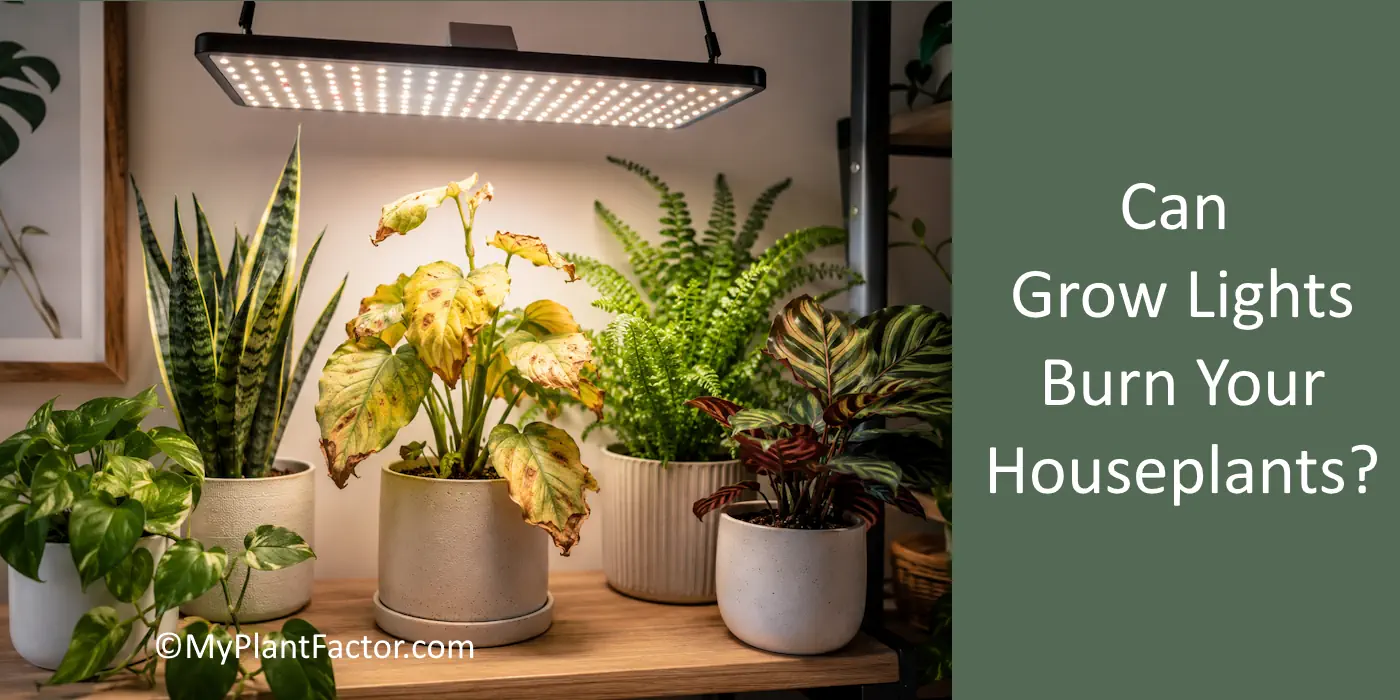
Light burn shows up as yellowing or browning on the leaves closest to the light, crispy or curled edges, and pale or bleached patches on upper foliage. It’s easy to confuse with underwatering or nutrient deficiency — the tell is that damage concentrates on the side or leaves nearest the light source, not scattered across the whole plant.
That location pattern is the fastest diagnostic shortcut. Underwatering and nutrient problems tend to show up on older, lower leaves first, or evenly across the plant. Light burn does the opposite — it hits the leaves physically closest to the bulb, often on just one side of the plant if the light is mounted off-center.
| Symptom | What It Looks Like | Commonly Confused With |
|---|---|---|
| Yellowing near the light | Leaves closest to the bulb turn pale yellow, while other leaves stay green. | Nitrogen deficiency, which usually affects older leaves first and causes more uniform yellowing. |
| Bleached or white patches | Faded, papery-looking patches appear across the upper leaf surface. | Powdery mildew or another fungal issue. |
| Crispy, curled edges | Leaf margins dry out, curl inward, and feel brittle. | Underwatering or low humidity. |
| Brown scorch spots | Dark, dry patches develop directly beneath the light’s strongest hotspot. | Sunburn from a nearby window or chemical leaf burn caused by fertilizer. |
| Stunted new growth near the light | New leaves emerge smaller and paler than the plant’s older growth. | Insufficient light—the opposite problem, and an easy one to misread. |
If the damage pattern doesn’t match the light’s position — for instance, yellowing on the far side of the plant from the light — the cause is more likely watering or nutrition. Check the soil and feeding schedule before assuming light burn.
What Actually Causes It — Distance, Intensity, or Hours?
Light burn on houseplants comes down to three variables: the light is too close to the canopy, the light’s intensity is too high for that plant’s natural tolerance, or it’s running more hours per day than the plant needs. Any one of the three can cause it — most real cases are a combination of two.
Distance is the most common cause on houseplant setups specifically. Most full-spectrum LED grow lights are rated for 12–24 inches from mature foliage, depending on wattage. Mounting one at seedling distance (6–8 inches) over an established plant concentrates far more light and heat per square inch of leaf than the plant is built to tolerate.
Intensity matters less on houseplant-grade lights than it does on grow-tent equipment, but it’s not zero. A high-output panel bought for starting seeds or growing herbs, then pointed at a shade-adapted tropical like a calathea, delivers more PPFD (photosynthetic photon flux density) than that plant’s natural understory environment ever would. The article on best grow lights for indoor plants — PPFD and wattage explainer covers the full mechanism.
Hours compound the other two. A plant tolerating 10 hours a day at a safe distance can start showing stress at 16 hours under the same setup — light stress is cumulative, not a simple pass/fail based on distance alone.
Most burn cases MPF has diagnosed involve two of the three at once — usually a light mounted slightly too close, left on a long timer, on a plant that wasn’t a good candidate for supplemental lighting to begin with.
🌿 Not Worth the Risk for Every Plant
Thin-leaved, shade-adapted plants — the same ones most prone to light burn — are often better off without a grow light in the first place. Several common houseplants handle low light well enough on their own that adding a light just introduces a risk that wasn’t necessary.
See which houseplants skip the grow light requirement entirely →
Which Houseplants Burn Fastest Under a Grow Light
Thin-leaved and low-light-adapted houseplants — pothos, philodendron, calathea, and most ferns — scorch faster than thicker-leaved or higher-light plants like succulents, snake plants, or hoyas. The understory tropicals most common in home collections are exactly the ones most likely to show burn first, not last.
This is the piece most grow light guides skip entirely, because most of them are written for cannabis growers or vegetable gardeners — plants bred and selected for high light tolerance. Common houseplants are a different category. Many evolved as forest-floor or understory species, adapted to filtered, indirect light rather than direct high-intensity exposure.
- Higher risk: pothos, philodendron erubescens, calathea, ferns, peace lily, prayer plants — thin leaves, shade-adapted, low natural light tolerance
- Lower risk: snake plants, succulents, hoya, cacti — thicker or more leathery foliage, evolved for brighter natural conditions
Discover if you need grow lights to boost snake plant growth.
I’ve seen the same setup mistake repeatedly: a grow light bought and dialed in for a snake plant or succulent shelf, then a pothos gets added to the same setup at the same distance. The snake plant is fine. The pothos scorches within a week.
The fix isn’t a different light — it’s a different distance or a separate zone for the more sensitive plant. Grouping plants by light tolerance, not just by convenience, avoids this entirely.
Is Grow Light Buzzing or Humming Normal?
A faint hum from a grow light’s driver is common and not dangerous — it’s usually the internal transformer vibrating, not a sign of malfunction. A loud or new buzzing noise is worth checking: it can mean a loose bulb, driver failure, or, rarely, a wiring issue that needs unplugging and inspecting.
This isn’t a plant-health issue — it’s an electrical one, and it’s a much smaller concern than burn risk. Most quiet, consistent hums are the driver’s internal electronics (transformers, coils, capacitors) vibrating under normal current load. That’s cosmetic, not a safety signal.
A sudden change matters more than a constant baseline hum. If a previously quiet light starts buzzing louder, or a new light is unusually loud out of the box, unplug it and check the bulb seating and power connection before continuing to run it unattended.
Depending on the type, some varieties of hoyas can benefit from being under grow lights.
How to Fix Light Burn (Once It’s Already Happened)
Move the light 4–6 inches farther from the plant, cut daily light hours by 1–2 hours, and trim any leaves with severe burn damage — they won’t recover, but new growth will be fine once conditions are corrected. Most houseplants bounce back within 2–3 weeks of the fix; burned leaves are cosmetic damage, not usually a sign of lasting harm.
Burned tissue doesn’t heal. A yellowed or crisped leaf will stay that way regardless of what changes afterward — the goal isn’t to reverse existing damage, it’s to stop it from spreading to new growth.
| Fix | When to Use It |
|---|---|
| Raise the light 4–6 inches | Use this first for any confirmed light burn. It’s the cheapest, fastest fix and addresses the most common cause. |
| Cut daily light exposure by 1–2 hours | Use this when the distance is already correct, but symptoms continue—or the light currently runs for 14 hours or longer. |
| Move the plant to indirect ambient light | Best for consistently sensitive plants, including ferns and calatheas, when a corrected setup still causes mild stress. |
| Trim severely damaged leaves | Wait until new, unaffected growth appears. Then remove dead tissue without placing extra stress on the plant. |
| Separate high- and low-tolerance plants | Use different setups when the same light serves plants with very different needs, such as a snake plant and pothos. |
Don’t trim damaged leaves immediately after adjusting the light. Wait until new growth confirms the fix is working — removing too much foliage at once adds stress on top of an already-stressed plant.
Frequently Asked Questions
Can grow lights actually hurt houseplants?
Yes, but the usual cause is heat or excessive intensity rather than the light itself. Most cases trace back to a grow light mounted too close or left on for too many hours.
Both problems are usually fixable without replacing the light.
What does light burn look like on a houseplant?
Light burn usually causes yellowing, browning, bleached patches, or crispy edges on the leaves closest to the bulb.
The location matters. Damage concentrated near the light helps separate grow light burn from watering problems or nutrient deficiencies.
Is it normal for a grow light to feel hot?
LED grow lights normally feel warm, but they should not become painfully hot after a brief touch.
If the housing feels genuinely hot, check the recommended mounting distance and make sure vents are not blocked.
How close is too close for a grow light?
The correct distance depends on the light’s wattage and design. Most full-spectrum LEDs used over mature houseplants sit around 12–24 inches above the foliage.
A light positioned only 6–8 inches above an established plant can cause burn unless the manufacturer specifically recommends that distance.
Can a grow light burn a succulent or cactus?
Yes, although it is less common. Succulents and cacti tolerate stronger light than shade-adapted tropical plants.
Burn on these plants usually means the grow light is significantly too close or the plant was moved into intense light too quickly.
How do I fix a plant that has already been burned by a grow light?
Raise the light by 4–6 inches and reduce the daily schedule by 1–2 hours. Leave damaged leaves in place until healthy new growth appears.
Most houseplants begin showing improvement within two to three weeks after the setup is corrected.
How many hours a day is too many for a houseplant grow light?
Most houseplants grow well with 10–14 hours of artificial light each day.
Running a grow light much longer can create cumulative stress, even at a reasonable distance. Reducing the schedule often helps when moving the light higher does not stop the symptoms.
