


As an Amazon Associate I earn from qualifying purchases at no extra cost to you.
Choosing cat-safe purple plants is one of the trickier plant colors to shop for when you have cats. Several of the most popular purple houseplants — Purple Heart, Purple Iris, Wisteria — are toxic or mildly toxic to cats, which makes an honest, verified list like this actually useful rather than decorative.
For toxicity severity across houseplants generally, not just purple ones, the full severity guide covers what’s actually dangerous versus commonly overstated.
Table of Contents
- Quick Picks if You’re in a Hurry
- What Makes a Purple Plant Safe for Cats?
- Cat-Safe Purple Houseplants
- African Violet (Saintpaulia ionantha)
- Purple Calathea (Calathea roseopicta and related species)
- Purple Orchid (Phalaenopsis sp.)
- Purple Bromeliad (various genera)
- Purple Echeveria (Echeveria ‘Perle von Nürnberg’ and similar varieties)
- Purple Waffle Plant (Hemigraphis alternata)
- Purple Passion Plant (Gynura aurantiaca)
- Gloxinia (Sinningia speciosa)
- Catnip (Nepeta cataria)
- Sweet Potato Vine (Ipomoea batatas — purple varieties)
- Cat-Safe Purple Plants for Outdoors
- Purple Plants That Aren’t Safe — Worth Knowing Before You Buy
- Placing Purple Plants When You Have Cats
- Frequently Asked Questions
All plants in the main section below are on the ASPCA’s non-toxic list for cats or are confirmed non-toxic by veterinary sources.
One thing worth clarifying before we go further: non-toxic means they won’t cause serious harm or organ damage. It doesn’t mean zero reaction — any plant material eaten in quantity can cause mild stomach upset in cats.
The goal here is to remove serious risk, not to guarantee a perfect afternoon.
Quick Picks if You’re in a Hurry
| Plant | Best For | Light | Difficulty | ASPCA Status |
|---|---|---|---|---|
| African Violet | Easiest purple blooms | Low to medium indirect | Easy | ✓ Non-toxic |
| Purple Calathea | Bold foliage in lower light | Medium indirect | Moderate | ✓ Non-toxic |
| Purple Orchid | Elegant long-lasting flowers | Bright indirect | Moderate | ✓ Non-toxic |
| Purple Waffle Plant | Compact vivid foliage | Bright indirect | Easy | ✓ Non-toxic |
| Purple Passion Plant | Unique velvety purple leaves | Bright indirect | Easy to moderate | ✓ Non-toxic |
What Makes a Purple Plant Safe for Cats?
A plant is considered safe when it appears on the ASPCA’s non-toxic list for cats, or when veterinary toxicology sources confirm no significant harmful compounds. The ASPCA database is the most widely referenced — it classifies plants as toxic or non-toxic, with notes on the relevant compounds where they exist.
Two things worth understanding before you buy:
Non-toxic doesn’t mean digestible. Even plants with no toxicity risk can cause vomiting or loose stools if your cat eats a meaningful amount. Cats are obligate carnivores — their digestive systems aren’t built for plant matter. The risk from non-toxic plants is usually mild and self-limiting.
There’s a middle category. Some plants are classified as “mildly toxic” — they cause irritation rather than organ damage. Purple Heart Plant falls here. It’s not safe, but it’s also not in the same category as Autumn Crocus. More on both below.
When in doubt, search the ASPCA database directly before you buy anything new.
Cat-Safe Purple Houseplants
Ten indoor plants, all ASPCA-verified or confirmed non-toxic. Each one has genuine purple — not a stretch of the definition.
| Plant | Purple type | Light | Difficulty | ASPCA status |
|---|---|---|---|---|
| African Violet | Blooms | Low–medium indirect | Easy | ✓ Non-toxic |
| Purple Calathea | Foliage (undersides) | Medium indirect | Moderate | ✓ Non-toxic |
| Purple Orchid | Blooms | Bright indirect | Moderate | ✓ Non-toxic |
| Purple Bromeliad | Bracts / blooms | Bright indirect | Easy | ✓ Non-toxic |
| Purple Echeveria | Full rosette | Full sun / bright | Easy | ✓ Non-toxic |
| Purple Waffle Plant | Foliage (full) | Bright indirect | Easy | ✓ Non-toxic |
| Purple Passion Plant | Foliage (full) | Bright indirect | Easy–moderate | ✓ Non-toxic |
| Gloxinia | Blooms | Bright indirect | Moderate | ✓ Non-toxic |
| Catnip | Flowers (white-purple) | Full sun / bright | Easy | ✓ Non-toxic |
| Sweet Potato Vine | Foliage (full) | Full sun | Easy | ✓ Non-toxic |
For more bloom-heavy options, my cat safe flowers guide covers African violets, orchids, asters, and other non-toxic flowers that work better around curious cats.
African Violet (Saintpaulia ionantha)
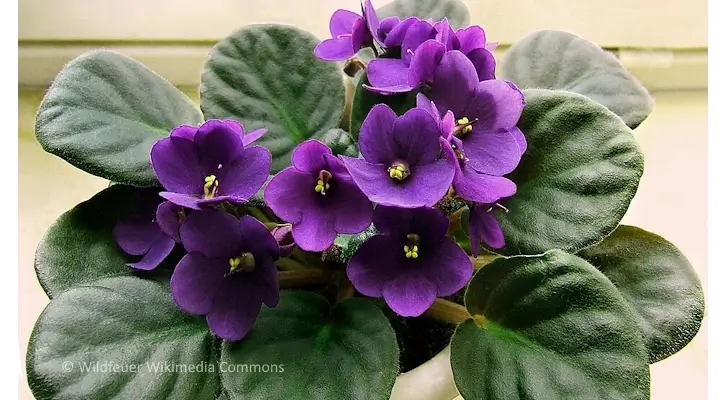
One of the most reliably purple plants you can keep indoors, and genuinely easy to maintain once you sort out the watering. African Violets bloom almost continuously in low to medium indirect light — which covers most windowsills in practice.
Water from below to avoid spotting the leaves. They don’t like cold water on their foliage and they don’t like drying out completely between drinks. If yours stops blooming, it usually needs more light or a light fertiliser dose. Otherwise, they’re undemanding.
ASPCA status: Non-toxic to cats and dogs.
Purple Calathea (Calathea roseopicta and related species)
The purple in Calathea is on the undersides — deep burgundy-purple with silvery or dark green patterning on top. In decent light, the undersides glow. These plants also move: they fold upward at night and open again in the morning, which cats find mildly interesting and completely harmless.
Calatheas are honest about their needs: consistent moisture without waterlogging, no direct sun, reasonable humidity. The main failure points are inconsistent watering and dry indoor air in winter. Not the easiest plant on this list, but not difficult once the routine is established.
ASPCA status: Non-toxic to cats and dogs.
For more variety options, see the purple houseplants guide.
Purple Orchid (Phalaenopsis sp.)
Moth Orchids in purple are widely available and one of the more refined options here. The blooms last weeks to months on a healthy plant. Between bloom cycles they look unremarkable — a few strap-like leaves — but they come back reliably if you let them rest properly rather than throwing them out.
Water thoroughly, then let the pot drain and dry slightly before watering again. Bright indirect light, no standing water. Fertilise lightly during the growing season. Most orchid deaths are overwatering or post-bloom abandonment — both avoidable.
ASPCA status: Non-toxic to cats and dogs.
Purple Bromeliad (various genera)
Bromeliads are almost indestructible. They hold water in a central cup, tolerate a fair amount of neglect, and produce purple in both the bracts and blooms depending on the variety.
Keep the central cup topped up and change the water occasionally to prevent stagnation. Use well-draining mix. The main bloom cycle happens once; after that the plant produces pups (offsets) that you can separate and grow on. Cats generally leave these alone — the texture doesn’t invite chewing.
ASPCA status: Non-toxic to cats and dogs.
Purple Echeveria (Echeveria ‘Perle von Nürnberg’ and similar varieties)
Purple succulents tick a lot of boxes for cat households — compact, slow-growing, and not particularly appealing to chew. Echeveria ‘Perle von Nürnberg’ is the most commonly available purple variety, with dusty pink-purple rosettes that deepen in colour with more light.
They need bright light and infrequent watering. Let the soil dry completely between waterings. The main error is overwatering — the rosette goes mushy from the centre and that’s usually the end of it.
ASPCA status: Non-toxic to cats and dogs.
Purple Waffle Plant (Hemigraphis alternata)

One of the more vivid foliage plants on this list. The leaves have a deep metallic purple underside and a crinkled, textured surface that holds colour year-round. It stays compact, works well in terrariums, and has some documented air-purifying properties from older NASA research.
It needs bright indirect light to maintain the purple. In low light it fades toward green. Keep the soil consistently moist and humidity reasonable — this is not a drought-tolerant plant.
ASPCA status: Non-toxic to cats and dogs.
Full care breakdown: Purple Waffle Plant guide.
Purple Passion Plant (Gynura aurantiaca)

Often overlooked, which doesn’t make much sense once you see it. The leaves are covered in fine purple hairs that catch the light and give the plant a velvety, almost iridescent sheen. It’s genuinely unusual-looking and propagates easily from cuttings.
Give it bright indirect light and let it trail or climb — it gets leggy in low light. Water when the top inch of soil dries out. Pinch back leggy stems to keep it bushy. The flowers, if it produces them, smell unpleasant; most growers remove them before they open. Small trade-off for the foliage.
ASPCA status: Non-toxic to cats and dogs.
Full plant profile: Gynura aurantiaca care guide.
Gloxinia (Sinningia speciosa)
In the same family as African Violets, Gloxinia produces large, velvety trumpet-shaped blooms in rich purple — often with white edging. It’s a seasonal bloomer: intense flower production followed by a dormant period. The blooms are worth the wait.
Treat it like an African Violet: bright indirect light, bottom watering preferred, avoid cold water on leaves. During dormancy, reduce watering significantly and keep it somewhere cool. It’ll come back the following season.
ASPCA status: Non-toxic to cats and dogs.
Catnip (Nepeta cataria)
The obvious one, and worth including explicitly. Catnip produces purple-white flower spikes and is categorically the most cat-safe plant on this list — cats can roll in it, chew it, and generally cause chaos without any toxicity concern whatsoever.
Grow it in a pot in a sunny spot. It’s vigorous and a little unruly indoors. If your cat discovers it in the pot, you’ll probably need to sacrifice the plant or keep it elevated. Most growers keep a dried bunch accessible and the live plant somewhere out of reach.
ASPCA status: Non-toxic to cats and dogs.
Sweet Potato Vine (Ipomoea batatas — purple varieties)
Deep purple heart-shaped leaves, fast growth, and flexibility — it works in hanging baskets, large pots, or trailing from a shelf in bright light. It rarely flowers indoors; the foliage is the point.
It likes consistent moisture and full sun to partial shade. In lower light, the purple fades. It grows quickly enough that minor cat attention doesn’t usually cause lasting damage — the plant generally outpaces it.
ASPCA status: Non-toxic to cats and dogs.
Cat-Safe Purple Plants for Outdoors

Most cat-safe plant content stops at houseplants. If you have a garden or an outdoor cat, these options give you purple without the risk.
Lavender (Lavandula) — The plant itself is non-toxic to cats according to the ASPCA. Lavender essential oil is a different matter entirely and should be kept well away from cats. The plant in the ground or a pot outdoors is generally fine — most cats find the scent mildly off-putting anyway, which is a bonus if you’re trying to protect a border.
Echinacea / Coneflower (Echinacea purpurea) — Purple daisy-like flowers, drought tolerant once established, popular with pollinators. ASPCA lists it as non-toxic to cats and dogs. A reliable garden perennial that asks very little once it’s settled in.
Catmint (Nepeta mussinii / Nepeta × faassenii) — Similar effect to catnip but less intense. Produces long spikes of soft purple-blue flowers. Non-toxic, tough, drought-tolerant. Cats often enjoy rolling in it. It handles this better than most plants would.
Asters — Purple daisy-like perennials that bloom in late summer and autumn when most other garden colour has faded. Non-toxic. Low maintenance once established.
Lilyturf (Liriope muscari) — An evergreen ground cover with upright purple flower spikes in late summer. Non-toxic, shade-tolerant, handles dry conditions reasonably well. An underused option for cat-safe garden planning.
For additional outdoor varieties, the blue and purple flowers guide covers more perennial and garden options in this colour range.
Purple Plants That Aren’t Safe — Worth Knowing Before You Buy

The plants below are popular, widely grown, and frequently mistaken for safe options. They’re not.
Purple Heart Plant (Tradescantia pallida) — This is the one that causes the most confusion. Purple Heart is one of the most widely grown purple houseplants, and it’s classified as toxic to cats by the ASPCA. It contains compounds that cause skin irritation and gastrointestinal upset if ingested. Symptoms are usually mild — vomiting, drooling, skin irritation — but that’s not a reason to keep it where cats can reach it.
If you’re already growing it, elevate it rather than trailing it somewhere accessible. The Purple Heart Plant care guide has more on identification and growth habits. If you’re not sure whether what you have is Purple Heart or something else, the Tradescantia pallida identification guide should help.
Tradescantia zebrina (Inch Plant / Wandering Dude) — Same genus as Purple Heart, similar toxicity classification. Sometimes sold under names that sound more benign. Check the scientific name before buying anything in the Tradescantia family.
Purple Iris — All parts of the iris plant are toxic to cats, including leaves, flowers, and especially the rhizomes. The compounds involved — irisin, iridin — cause vomiting, drooling, and lethargy. Not a borderline case.
Wisteria — Highly ornamental, significantly problematic. All parts of the plant are toxic, with seeds and seed pods being the most dangerous. Causes vomiting, diarrhoea, and in larger quantities, more serious symptoms.
Autumn Crocus (Colchicum autumnale) — Often produces purple flowers and is sometimes confused with standard garden crocuses, which carry lower risk. Autumn Crocus is seriously toxic — it can cause multi-organ failure. If there’s any doubt about what you have, don’t plant it near cats.
If your cat has eaten any of the above, contact the ASPCA Animal Poison Control Center or your nearest emergency vet. Don’t wait for symptoms to develop.
Placing Purple Plants When You Have Cats
Non-toxic plants are the foundation, but placement still matters — mostly for the plant’s sake.
Hanging planters work well for trailing varieties like Sweet Potato Vine. Wall-mounted shelves keep succulents and African Violets visible but out of serious reach. Most cats lose interest in a plant quickly if they can’t physically access it. The challenge is usually the first week of novelty.
Terrariums and glass containers protect smaller plants like Gloxinia or African Violet from direct interference while keeping them on display. For persistent cats, a closed terrarium removes the problem almost entirely.
If you’re dealing with a cat that’s actively interested in your plants regardless of placement, the guide to keeping cats away from plants covers deterrent strategies and practical approaches that don’t require sacrificing the whole collection.
Cat-Safe Purple Plants: FAQs:
Are there any purple plants safe for cats?
Yes—several. African Violet, Purple Calathea, Purple Orchid, Purple Waffle Plant, Purple Bromeliad, and Purple Passion Plant are all on the ASPCA non-toxic list for cats. The full article covers 10 indoor options and 5 outdoor garden plants.
Is Purple Heart Plant safe for cats?
No. Purple Heart Plant (Tradescantia pallida) is classified as toxic to cats by the ASPCA. It causes skin and gastrointestinal irritation if ingested. Symptoms are usually mild, but it’s worth keeping out of reach or replacing with a non-toxic alternative.
Is African Violet safe for cats?
Yes. African Violet (Saintpaulia ionantha) is ASPCA-verified non-toxic to cats and dogs. It’s also one of the most consistently purple flowering houseplants available indoors, which makes it a practical first choice for cat households.
Is lavender safe for cats?
The lavender plant is listed as non-toxic to cats by the ASPCA. Lavender essential oil is a different matter—it’s concentrated and should not be used around cats. A potted lavender plant outdoors is generally considered fine.
Is Purple Passion Plant toxic to cats?
No. Gynura aurantiaca (Purple Passion Plant) is on the ASPCA non-toxic list for cats. It’s one of the more visually striking purple foliage plants available and a solid choice for pet households.
Can cats eat catnip safely?
Yes. Catnip (Nepeta cataria) is completely non-toxic to cats, and most cats actively seek it out. The reaction—rolling, rubbing, or mild sedation—is a harmless response to the compound nepetalactone and usually passes within about 10–15 minutes.
What should I do if my cat eats a purple plant?
If it’s from the safe list above, monitor for mild stomach upset—usually self-limiting within a few hours. If it’s a toxic plant, or you’re not certain what it was, contact the ASPCA Animal Poison Control Center (888-426-4435) or your vet immediately. Don’t wait for symptoms to appear before calling.
