



As an Amazon Associate I earn from qualifying purchases at no extra cost to you.
There are over 70 named snake plant varieties, but most indoor growers will encounter 15–20 of them. They split broadly into four groups: tall upright classics, compact dwarf types, sculptural cylindrical forms, and bold wide-leaf statement plants. The group matters more than the specific variety for care purposes — but it matters a lot for how the plant looks, how much space it takes up, and what happens when you try to propagate it.
You’ll see these plants sold under both Sansevieria and Dracaena names. That’s a 2017 reclassification, not a different plant — more on that below. This guide uses both names where it helps you find what you’re actually looking for.
What Are the Main Types of Snake Plants?
The main types of snake plants are tall upright classics, compact dwarf types, cylindrical sculptural varieties, and wide-leaf statement plants. Common examples include Laurentii, Zeylanica, Moonshine, Hahnii, Twisted Sister, Cylindrica, Fernwood, Whale Fin, and Kirkii. Most indoor growers will encounter 15–20 useful varieties, even though 70+ named types exist.
Jump to a section ▾
Sansevieria vs Dracaena — Why Your Plant Has Two Names
The short version: In 2017, DNA analysis confirmed that Sansevieria was too genetically close to Dracaena to be a separate genus. Botanists merged the two. Your plant didn’t change — just its scientific classification.
What this means practically: the plant sold as Sansevieria trifasciata is now officially Dracaena trifasciata. Same species, same care, different label. Nurseries update slowly, so you’ll still see Sansevieria tags everywhere — especially on older stock.
This guide uses both names where it helps. When a variety is better known by one name in shops (Cylindrica is still rarely sold as Dracaena angolensis), that’s the name used first.
Quick Comparison: Types of Snake Plants at a Glance
No two varieties require dramatically different care — they’re all drought-tolerant, all prefer well-draining soil, and none want to sit in water. But height, light tolerance, and space requirements vary more than most articles acknowledge.
| Variety | Max Indoor Height | Best Light | Drought Tolerance | Space Needed | Price Tier |
|---|---|---|---|---|---|
| Laurentii | 3–4 ft / 90–120 cm | Low–bright indirect | High | Medium | Budget |
| Zeylanica | 2–3 ft / 60–90 cm | Low–bright indirect | High | Medium | Budget |
| Moonshine | Up to 2 ft / 60 cm | Bright indirect (essential) | High | Medium | Budget–Mid |
| Black Coral | Up to 3 ft / 90 cm | Low–medium | High | Medium | Budget–Mid |
| Bantel’s Sensation | Up to 3 ft / 90 cm | Bright indirect | High | Medium | Mid–Premium |
| Hahnii (Bird’s Nest) | 8 in / 20 cm | Low–medium | High | Minimal | Budget |
| Twisted Sister | 12–18 in / 30–45 cm | Bright indirect | High | Minimal | Budget–Mid |
| Cylindrica | 2–4 ft / 60–120 cm | Bright indirect | Very high | Medium | Budget–Mid |
| Fernwood | 18 in / 45 cm | Low–medium | High | Small | Budget–Mid |
| Whale Fin | 3–4 ft / 90–120 cm | Low–bright indirect | High | Medium | Mid–Premium |
| Kirkii Silver Blue | 2–3 ft / 60–90 cm | Bright indirect | Very high | Small | Mid |
How to Identify Your Snake Plant Variety
If you already own one and you’re not sure what it is, check these five things first. They narrow it down quickly.
Five Visual Markers to Check
- Leaf shape — Is the leaf flat and sword-shaped, round and pencil-like, oval and paddle-wide, or low and rosette-forming? Flat leaves point to the classic trifasciata types. Cylindrical leaves are the Cylindrica/Fernwood/Mikado group. Paddle leaves are the Whale Fin.
- Leaf edge colour — Yellow margin means Laurentii, Golden Hahnii, Black Gold, or Twisted Sister. No margin (plain green or silver-grey) narrows it to Zeylanica, Moonshine, or Cylindrica. A red-brown edge is usually Zeylanica or Kirkii.
- Height cap — Does it sit under 30 cm and show no signs of growing taller? That’s the Hahnii group. Over 60 cm and still climbing? Classic trifasciata territory.
- Stripe pattern — Horizontal zig-zag bands of lighter green run across most trifasciata types. Vertical white stripes running along the length of the leaf are specific to Bantel’s Sensation. No visible patterning usually means Moonshine or Cylindrica.
- Leaf count and clustering — Many slim leaves shooting up from a central base is the standard trifasciata cluster form. A single wide leaf growing alone, or in pairs, is almost certainly a Whale Fin. A tight low rosette of short leaves points to the Hahnii family.
Five Most Commonly Confused Pairs
- Laurentii vs Zeylanica — Both have horizontal banding and similar height. The yellow leaf edge is the tell. No yellow margin? It’s Zeylanica.
- Moonshine vs standard trifasciata — Moonshine leaves are distinctly silvery-grey, not green. In low light, that silver fades and they look more alike than they should.
- Whale Fin vs Kirkii — Both are wide-leaved. Whale Fin grows one enormous single leaf at a time, usually over 15 cm wide. Kirkii spreads as a flatter, multi-leaf rosette with silver-blue tones and wavy edges.
- Cylindrica vs Fernwood — Cylindrica leaves are rigid, round, and hold straight. Fernwood leaves arch outward and are slightly grooved with a narrower profile. Both are cylindrical, but Fernwood has a softer, more sprawling habit.
- Hahnii vs Futura Superba — Both are compact, but Hahnii stays as a low rosette with short leaves fanning out horizontally. Futura Superba grows upright — shorter than a Laurentii, but definitely reaching for the ceiling.
Which Snake Plant Variety Should You Choose?
Choose Laurentii or Zeylanica if you want the easiest tall snake plant. Pick Hahnii or Whitney for small spaces. Choose Cylindrica, Fernwood, or Starfish for a sculptural look. Pick Whale Fin or Kirkii if you want a slow-growing statement plant. Rare varieties are best for bright rooms and patient growers.
Tall and Upright Classic Varieties
These are the snake plants most people picture. They grow as a cluster of upright sword-shaped leaves, typically reaching between 60 cm and 120 cm indoors. They’re the most widely available, the most forgiving, and — with the exception of the Moonshine — the most adaptable to varying light conditions.
Laurentii (Dracaena trifasciata ‘Laurentii’)

The one most people already own without knowing its name. Laurentii has the characteristic horizontal grey-green banding on its leaves with a bright yellow margin running the full length of both edges. It’s the default snake plant at every garden centre, and it earns that position — it handles neglect, low light, and irregular watering better than most houseplants.
Height indoors: typically 90–120 cm. Discover how big do snake plants really get.
The Laurentii propagation warning: If you propagate Laurentii by leaf cuttings — which is the most common method — the new plants will be plain green. The yellow variegation is not genetically stable in the leaf cells; it’s maintained at the rhizome level. Division (splitting the plant at the root clump) is the only way to get new Laurentii plants that keep their yellow edges. [Find out the best ways to propagate snake plants]
Zeylanica (Dracaena zeylanica)

Looks like a Laurentii that lost its yellow edges. The horizontal banding is similar — grey-green zig-zag bands on a darker green background — but there’s no yellow margin, and the banding often has a slightly silvery quality. It’s frequently mislabelled in shops, sometimes as “Sansevieria trifasciata” without any cultivar name. Hardy, tolerant, and honest in its aesthetic.
Height indoors: 60–90 cm. One of the best choices for genuinely low-light spaces.
Black Gold (Dracaena trifasciata ‘Black Gold’)
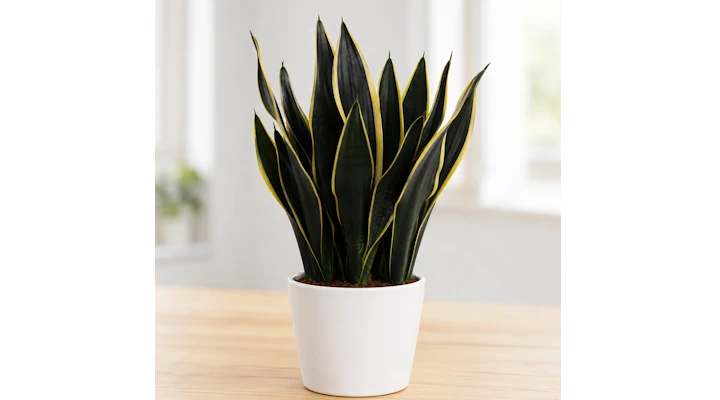
Similar to Laurentii but with darker, more deeply green leaves and a narrower gold edge. The contrast is sharper, which suits contemporary interiors better than the classic Laurentii. Slightly less common in garden centers, but not hard to find. Care is identical to Laurentii, including the leaf-cutting variegation loss.
Height indoors: 90–120 cm.
Black Coral (Dracaena trifasciata ‘Black Coral’)
Deep forest green leaves with silver-grey horizontal bands. No yellow edge — the colour palette is deliberately dark and dramatic. Works well in rooms with dark or neutral decor. Tolerates lower light than the Moonshine and doesn’t rely on bright conditions to maintain its look, which makes it more reliable than its reputation suggests.
Height indoors: up to 90 cm.
Moonshine (Dracaena trifasciata ‘Moonshine’)

The silver-grey outlier of the classic group. Young Moonshine leaves emerge very pale — almost white — and mature to a soft silvery-green. It’s genuinely striking if you give it the right conditions. Most care articles describe it as low-light tolerant. That’s only half the story.
Moonshine light warning: Moonshine needs bright indirect light to maintain its silver quality. In low or medium light, the leaves shift toward standard green and the variety loses the visual quality that makes it worth growing. It won’t die in low light — it just won’t look like a Moonshine anymore. Don’t place it in a dim corner and expect it to stay silver.
Height indoors: up to 60 cm. Slower-growing than the Laurentii.
Bantel’s Sensation (Dracaena trifasciata ‘Bantel’s Sensation’)
The vertical-stripe exception. Most snake plants have horizontal banding; Bantel’s has white vertical stripes running the length of each narrow leaf. It was patented in 1948 and has a distinctly different visual character from everything else in this group. Grows slowly, stays narrower than a Laurentii, and has collector appeal without being deeply obscure.
Height indoors: up to 90 cm. Availability has improved — specialist online nurseries stock it reliably now.
Futura Superba (Dracaena trifasciata ‘Futura Superba’)
A compact Laurentii. Same yellow-margin leaf, same horizontal banding, same care needs — but it caps out around 35–40 cm. Good for shelves and windowsills where a full-height Laurentii wouldn’t fit. Often sold without being identified by cultivar name, which is why it gets confused with its larger parent. Check the height if you’re buying a young plant — a Futura Superba won’t outgrow the shelf.
Compact and Dwarf Varieties (Small Space Snake Plants)
These are often dismissed as the “boring little ones” — the ones in 4-inch nursery pots near the checkout. That’s not fair. These are the varieties that actually fit in real apartments, real desks, and real windowsills without requiring a plan. If you’re growing plants in a small space, the Hahnii group deserves more respect than it usually gets.
Hahnii — Bird’s Nest Snake Plant (Dracaena trifasciata ‘Hahnii’)

The most common compact variety. Leaves fan out in a low rosette, rarely exceeding 20 cm in height. It looks like a small funnel of leaves rather than the upright sword cluster of the Laurentii group. Often the cheapest snake plant available — and one of the toughest. Tolerates dim conditions and dry soil as well as any variety in this list.
Golden Hahnii (Dracaena trifasciata ‘Golden Hahnii’)
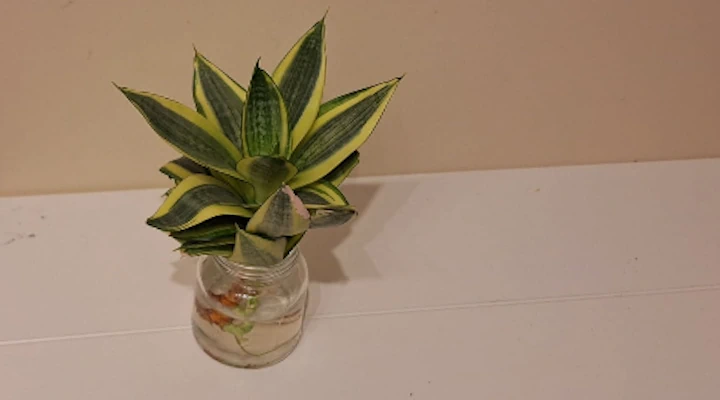
Same rosette form as the standard Hahnii, with a yellow edge on each leaf. More popular than the all-green version, and slightly harder to find. The yellow edge makes it visually livelier without changing the care requirements at all. Same variegation caveat applies — leaf cuttings will lose the yellow edge.
Twisted Sister (Dracaena trifasciata ‘Twisted Sister’)
A Hahnii hybrid with a twist — literally. The leaves curl and recurve outward, giving it a more dynamic appearance than the neat rosette of a standard Hahnii. Yellow edges, compact habit, stays under 45 cm. More visually interesting than its size suggests. If you want a desk plant that actually gets noticed, this is a reasonable choice.
Whitney (Dracaena trifasciata ‘Whitney’)
A compact rosette with wide yellow margins and darker, more richly coloured green centres. Usually 4–5 sturdy leaves, rarely more. Less common than the other Hahnii variants and somewhat underrated — the wide margins make it bolder-looking than its small size implies. Worth seeking out if you find one.
Cylindrical and Sculptural Varieties
These break the visual mould. Someone encountering them in a shop without prior knowledge often doesn’t recognise them as snake plants at all. The leaves are round in cross-section rather than flat — ranging from pencil-thick to finger-wide — and the growth habit is completely different from the flat-leaf classics.
Cylindrica — African Spear (Dracaena angolensis)

Round, rigid, grey-green leaves that grow straight up like spears. Mature leaves can reach 1–2 cm in diameter and get tough enough to hold their form without support. One of the most drought-tolerant snake plants — the cylindrical leaves store water efficiently, and in the wild this plant grows in rocky, very dry conditions.
On the braided Cylindrica: Most Cylindrica sold in shops have their young leaves braided together — a decorative technique done while the leaves are still flexible. That braid is artificial and permanent only for the leaves that were braided. Any new growth that emerges will come in straight and unbraided. You’re not buying a plant that naturally grows that way. If you want the braided look long-term, new leaves need to be manually encouraged — which most plant owners don’t do. Factor that into whether the braid matters to you.
Height indoors: 60–120 cm depending on conditions and how many growth points it has.
Fernwood (Dracaena parva × Dracaena pinguicula hybrid)
A hybrid with arching, narrower cylindrical leaves that curve outward from the base rather than growing rigidly upright. It clusters densely and stays more compact than Cylindrica. The leaves have a slightly grooved surface compared to the smooth round profile of a true Cylindrica. Tolerates lower light better than Cylindrica and is a solid choice for smaller spaces where the African Spear would be too large.
Height indoors: around 45 cm.
Mikado (Dracaena bacularis)
Similar to Cylindrica but thinner, lighter green, and with a more elegant profile. Individual stems are slimmer and more numerous, giving the plant a denser, grassier look. Less bold than Cylindrica, more refined. Height indoors: 60–90 cm.
Starfish Snake Plant — Boncel (Dracaena cylindrica ‘Boncel’)
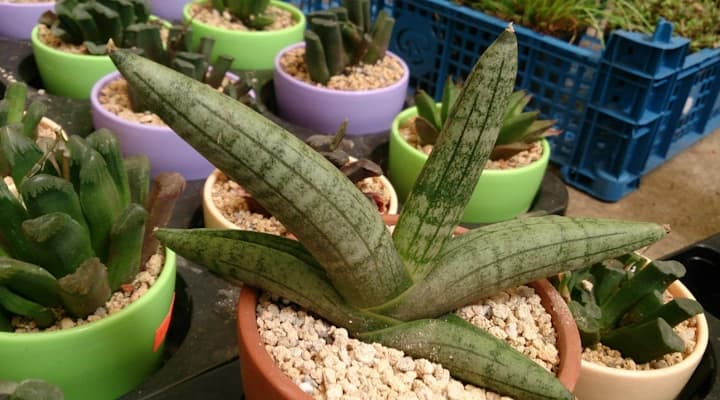
Short, cylindrical leaves fan out in a low, wide pattern. From above, it genuinely looks like a starfish — five or six thick leaves radiating from a central point, rarely more than 20–25 cm tall. It’s a conversation piece and a genuine compact alternative to the Hahnii if you want something more unusual. Rarer than the Fernwood or Mikado, but not hard to source online.
Wide-Leaf and Statement Varieties
These plants are for people who want one focal point rather than a cluster. Wide leaves, architectural form, slow growth — they earn their space by presence rather than volume.
Whale Fin (Dracaena masoniana)
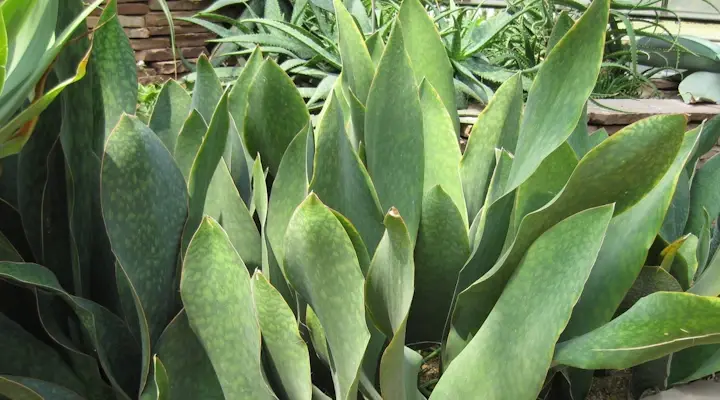
This is a different species from the trifasciata group, not a cultivar of it. The leaf is enormous — typically 15–25 cm wide, growing as a single upright paddle. Most plants you’ll find in shops are sold as a single leaf in a pot, though mature plants eventually produce a second or third leaf. Growth is slow. Expect one new leaf per season in good conditions, nothing in poor ones.
The Whale Fin is more expensive than most snake plants because of its slow growth rate — what you’re paying for is mainly the nursery’s patience. It tolerates a wide light range, but slower growth in lower light means you’ll wait longer between new leaves. Bold, architectural, and distinctly different from anything else in the snake plant family.
Kirkii Silver Blue (Dracaena kirkii or Sansevieria kirkii)
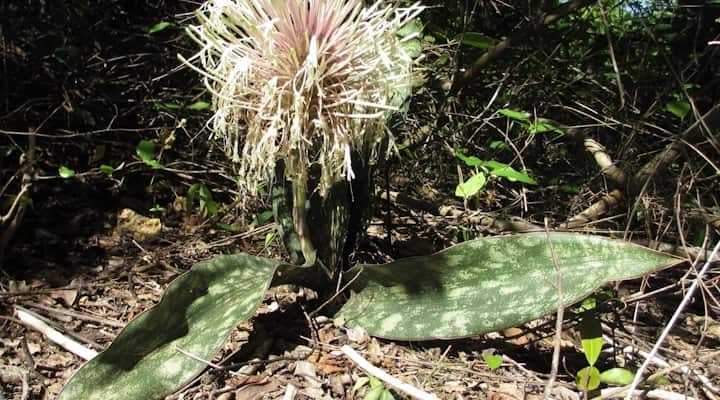
Compact but wide, with thick spreading leaves that carry a blue-silver sheen and distinctly wavy edges. The growth habit is unusual — it spreads outward rather than growing upward, forming a low rosette of substantial leaves rather than an upright cluster. The silver-blue quality is more pronounced in brighter light. Sometimes sold under the botanical name Dracaena pethera.
Coppertone Kirkii (Dracaena kirkii ‘Coppertone’)
Same genus as the Silver Blue but with an unusual copper-brown leaf coloration. It’s an acquired look — not the clean greens and silvers of most snake plants. Worth knowing it exists, though it’s not a recommendation for everyone. Those who like it tend to really like it; those who don’t will find it drab. Stock varies — check specialist nurseries and Etsy sellers.
Rare Snake Plant Varieties Worth Tracking Down
“Rare” in houseplant terms usually means one of two things: hard to find at a garden centre, or genuinely difficult to propagate at scale and therefore expensive. A few snake plant varieties fall into both categories. Most just need a slightly longer search.
- Whale Fin Variegated — The standard Whale Fin is striking; the variegated version, with cream or yellow streaking on the paddle leaf, is more so. Significantly more expensive than the plain Whale Fin. Stock is limited and moves fast. Etsy plant sellers and specialist online nurseries are the best source.
- Metallica Siam Silver — Silvery, broad leaves with a subtle metallic sheen. Not easily confused with the Moonshine — the leaf form is different and the silver quality is more consistent even in moderate light. Harder to source than it should be given how attractive it is.
- Cleopatra — A compact rosette with highly patterned, deeply sculptural leaves. The pattern is more intricate than the standard Hahnii group and the leaf surface has a textured, almost reptilian quality. Rare but becoming more available through specialist growers.
- Bantel’s Sensation — Listed in the tall varieties above but worth mentioning here again. It was genuinely uncommon for decades but availability has improved through online nurseries in the last few years. If you see it in person, it’s worth buying.
- Midnight Shine — Deep, very dark green leaves with minimal banding. Less common than the Black Coral and harder to source reliably. More of a specialist find.
For rare varieties specifically, specialist online nurseries and Etsy plant shops are consistently the best source. Local garden centres rarely stock anything beyond Laurentii, Zeylanica, Hahnii, and occasionally Moonshine. Searching specifically for plant collectors rather than general plant retailers will usually turn up better stock.
Which Type of Snake Plant Is Right for You?
Match your situation to the right variety:
| Your Situation | Best Variety | Why |
|---|---|---|
| Almost no natural light | Zeylanica or Hahnii | Both tolerate genuinely dim conditions. Moonshine will not stay silver — skip it for dark rooms. |
| Shelf or desk — nothing over 45 cm | Hahnii, Golden Hahnii, Whitney, or Twisted Sister | The Hahnii cluster is the most forgiving. Twisted Sister if you want more visual interest. |
| Want something that looks like nothing else | Cylindrica or Whale Fin | Cylindrica for tall and structural; Whale Fin for one bold leaf as a focal point. Both are slow-growers — buy the shape, not the speed. |
| Already have a Laurentii, want something different | Moonshine, then Bantel’s Sensation | Moonshine is the natural next step — same care, completely different look. Bantel’s if you want collector appeal without going obscure. |
| Collector — want the unusual ones | Whale Fin Variegated, Kirkii Coppertone, Metallica Siam Silver, Cleopatra | Expect to source online. Prices vary; the Variegated Whale Fin commands the highest premium. |
| Want to propagate and keep the colour | Any non-variegated variety — OR use division, not leaf cuttings | Laurentii, Golden Hahnii, and Black Gold will revert to green from leaf cuttings. Division preserves the colour. Plain-green varieties (Zeylanica, Moonshine) propagate true from cuttings. |
Care Differences That Actually Matter Between Varieties
Most snake plant care guides treat every variety identically, which is mostly fine — but there are genuine differences worth knowing before you put the wrong plant in the wrong spot.
Light requirements vary more than the label suggests. Zeylanica, Hahnii, Fernwood, and the Black Coral handle genuinely low light and look essentially the same across the light spectrum. Moonshine needs bright indirect light to stay silver. All others tolerate lower light but grow more slowly, and in Laurentii and Black Gold, variegation becomes slightly less vivid. For the best tips on keeping your plants healthy, check out my snake plant care guide.
Cylindrical varieties are marginally more drought-tolerant than flat-leaf types. The tighter and rounder the leaf structure, the more water it stores. Cylindrica, Mikado, and Fernwood can go longer between watering than a Laurentii in the same conditions. Still, “longer between watering” doesn’t mean abandonment — all snake plants will decline if left bone dry for months.
Cold tolerance varies within the compact group. Thin-leaved Hahnii types show cold stress — brown edges, soft leaves — faster than thick-leaved types like the Whale Fin or Kirkii. If your windowsill gets genuinely cold in winter, move the Hahnii group away from the glass before temperatures drop.
The variegation propagation issue applies to the whole yellow-margin group. Laurentii, Golden Hahnii, Black Gold, Twisted Sister — any variety with a yellow edge will produce plain-green offspring from leaf cuttings. Division is the only propagation method that preserves the colour. This surprises people who propagate a Laurentii and get green plants back. It’s not a failed cutting — it worked exactly as it should, just without the variegation. Want to grow more snake plants from cuttings? Learn how to propagate snake plants in my helpful guide.
Soil is genuinely consistent across all varieties. Well-draining mix, no exceptions. The cylindrical varieties tolerate the driest conditions, but none of them want to sit in dense, moisture-retaining soil. Here’s my guide to the best type of soil for snake plants that includes well-draining, DIY potting soil mixes.
Are Snake Plants Safe for Cats?
No — and this applies to every variety in this guide, not just one. All snake plants contain saponins, a group of naturally occurring compounds the plant uses as a defence against insects and fungi. In cats, ingestion causes gastrointestinal irritation: nausea, drooling, vomiting, and occasionally diarrhoea. Symptoms are typically mild to moderate and resolve without lasting harm, but they’re unpleasant for the cat and stressful for the owner.
The toxicity level is consistent across varieties. A Hahnii on a low shelf carries the same risk as a full-height Laurentii — compact doesn’t mean safer. If you share your home with cats, placement matters more than variety choice.
If your cat has chewed or licked a snake plant leaf, the response depends on how much was ingested and the cat’s size. The full guide on snake plants and cats covers what to watch for, when to call a vet, and how to keep both the plant and the cat in the same home safely. For the specific scenario of a cat that’s had a single lick rather than a full chew, there’s a separate breakdown at what happens when a cat licks a snake plant.
Common Snake Plant Problems
Snake plants fail quietly and slowly — which means by the time something looks wrong, it’s usually been wrong for a while. These are the three most common problems across all varieties, with brief pointers on cause.
Leaves curling inward. Usually a response to stress — most often underwatering, low humidity, or temperature extremes. The leaf curls to reduce surface area and conserve moisture. It’s fixable if caught early. The full diagnostic is at snake plant curling: causes and fixes.
Leaves turning yellow. Overwatering is the most common cause — when roots stay wet too long, they lose the ability to take up nutrients and the leaves start to fade. But yellowing also happens in very low light, after repotting stress, or as the plant sheds old growth naturally. Each cause has a different fix. See snake plant turning yellow for a step-by-step diagnosis.
Leaves drooping or falling over. A firm upright snake plant that suddenly flops has usually lost root integrity — overwatering and root rot is the most likely culprit, especially in winter when the plant’s water needs drop but watering habits don’t. Drooping in a recently repotted plant is a different problem. Full walkthrough at snake plant drooping.
For tips on a watering schedule and basic care, the guide on day-to-day care covers everything in one place.
Frequently Asked Questions
How many types of snake plants are there?
There are over 70 named species and cultivars within the Sansevieria/Dracaena family. Most indoor growers will encounter 15–20 of them. The rest are collector plants that take more searching to find. The four main groups are tall upright classics, compact dwarf types, cylindrical sculptural varieties, and wide-leaf statement plants.
Is Sansevieria the same as a snake plant?
Yes. Snake plants were reclassified from Sansevieria into the Dracaena genus in 2017, based on DNA analysis showing the two groups were too genetically similar to be separate genera. The plant itself did not change, just its scientific classification. You will still see Sansevieria on labels because nurseries update slowly.
What is the most common type of snake plant?
Dracaena trifasciata ‘Laurentii’, the tall upright variety with yellow leaf margins, is the most widely sold snake plant worldwide. If you bought a snake plant from a garden centre or supermarket without a specific cultivar label, it is probably Laurentii or Zeylanica.
Which snake plant is best for very low light?
Zeylanica and basic Hahnii handle genuinely low light better than most snake plants. Moonshine is often marketed as low-light tolerant, but it usually loses its silver colouration in dim rooms. If the light is poor, Zeylanica or Hahnii is the safer choice.
Will my snake plant lose its yellow edges if I propagate it?
Yes, if you propagate by leaf cuttings. Yellow-margined varieties like Laurentii, Golden Hahnii, and Black Gold usually revert to plain green from leaf cuttings. Division, where you split the plant at the rhizome, is the only reliable way to preserve the yellow edge.
Can I plant different snake plant varieties together?
Yes. Different snake plant varieties can grow together because their care needs are almost identical. Choose a pot roughly 25–30% larger than the combined root mass, and avoid mixing a tiny dwarf variety with a very aggressive tall grower in a small pot.
What is the rarest snake plant you can buy?
Metallica Siam Silver, Midnight Shine, and variegated Whale Fin are among the hardest snake plants to source reliably. Bantel’s Sensation used to be much rarer, but specialist online nurseries have made it easier to find.
What’s the difference between a Whale Fin and a regular snake plant?
Whale Fin, or Dracaena masoniana, is a distinct species rather than a cultivar of Dracaena trifasciata. Its leaves are much wider and it usually grows one or two large leaves at a time. It grows slowly, which is one reason it often costs more than standard snake plants.
Do snake plants have any proven benefits?
Snake plants do release oxygen and absorb small amounts of airborne toxins, but the air-purifying claims are often overstated for normal homes. Their more practical benefits are easier to prove: they tolerate neglect, handle dry indoor air, and live for years with basic care.
Which snake plant is easiest to care for?
Zeylanica and the standard Hahnii are the most forgiving snake plants. Both tolerate irregular watering, low light, and general neglect without much visible decline. Laurentii is a close third, widely available and nearly indestructible. If you’ve killed houseplants before, start with any of those three.
What is the fastest-growing snake plant variety?
Laurentii grows faster than most snake plant varieties. In good conditions, expect around 4–12 inches of growth per year with bright indirect light, warmth, and growing-season watering. Compact varieties like Hahnii are slower. Whale Fin is one of the slowest, often producing roughly one new leaf per season.
Which snake plant is best for a bedroom?
Zeylanica is one of the best snake plants for a bedroom because it handles lower light better than many pale or heavily variegated types. For a small bedside table, choose Hahnii or Twisted Sister. For a bedroom corner, Laurentii or Cylindrica gives more height without needing much care.
Which snake plant stays the smallest?
The Hahnii group stays the smallest. Bird’s Nest, Golden Hahnii, and Whitney usually stay around 20 cm tall and rarely spread wider than 30 cm. Starfish, also called Boncel, is similarly compact at around 20–25 cm. These varieties stay desk and shelf sized long-term.
What’s the best snake plant for beginners?
Laurentii and Zeylanica are the best snake plants for beginners. Both are widely available, budget-friendly, and tolerant of common mistakes like low light, missed watering, and occasional overwatering. Hahnii is a good choice if space is limited. Moonshine is less forgiving because it loses its pale colour in low light.
How do I identify which type of snake plant I have?
To identify a snake plant, check the leaf shape, edge colour, height, growth habit, stripe pattern, and whether it grows as a cluster or single leaves. Flat leaves, cylindrical spears, yellow margins, low rosettes, vertical stripes, and paddle-wide leaves all point to different snake plant types.
The variety you start with matters less than finding the right fit for your space and light. Most snake plants are forgiving enough that you can course-correct if the first choice isn’t perfect. The ones most likely to disappoint are the Moonshine in dark spots and the Laurentii when propagated from a cutting — both cases where the plant does exactly what it’s supposed to, just not what the owner expected.
