


As an Amazon Associate I earn from qualifying purchases at no extra cost to you.
The best potting soil for snake plants is a fast-draining, airy mix that doesn’t stay wet for days. A cactus mix, succulent soil, or a succulent soil mix amended with perlite (and often pine bark) usually works best. Standard potting soil holds excess moisture too long, which is one of the fastest routes to root rot.
If your snake plant “mysteriously” declines, potting soil is often the quiet culprit. You can water perfectly and still lose the plant if the soil mix compacts and suffocates the roots. The fix is boring, but it works: drainage first, nutrients second.
Table of Contents
- Why Drainage Matters More Than Fertility
- What to Look For in a Good Snake Plant Potting Mix
- Quick Comparison Table (So You Don’t Overthink It)
- Best Store-Bought Soil Options
- DIY Soil Recipes (Pick One Based on Your Home)
- Changing Soil for a Snake Plant: Are the Roots Healthy?
- Can One Potting Soil Work for Snake Plant, Spider Plant, and Chinese Evergreen?
- FAQ
For the full snake plant hub covering pet safety, benefits, common problems, and setup, start with our comprehensive snake plant guide guide.
Why Drainage Matters More Than Soil Nutrients
All types of snake plants (Dracaena trifasciata) store water in their leaves and rhizomes, so they’re built for dry cycles. Their roots do best when they get oxygen and dry-down time, not constant dampness. When soil stays wet, the root ball loses airflow, and rot can start even if you’re watering “only a little.”
This is also why people get confused by yellowing leaves. Yellowing isn’t always “needs water.” With snake plants, yellowing leaves can show up when roots are stressed from staying too wet, especially in low light conditions.
Light matters here, too. In indirect sunlight the plant uses water more slowly, so heavy soil stays wet longer. A gritty mix buys you forgiveness when your home is cool, dim, or humid.
Getting the soil right is only part of the equation — proper watering and light matter just as much, which I explain in this basic Snake Plant Care article.
What to Look For in a Good Snake Plant Potting Mix

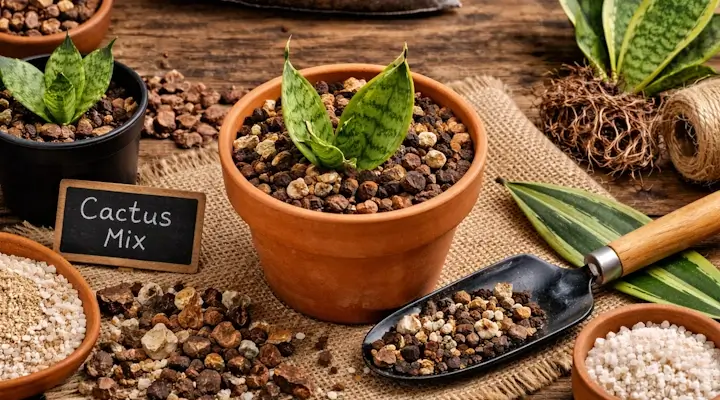
Good potting soil for snake plants feels light, gritty, and slightly chunky. It should drain quickly and resist compaction over time. If you squeeze it wet and it clumps into a dense ball, it’ll hold water too long.
Snake plants also do best in a mildly acidic to neutral mix — roughly 4.5 to 7.0 pH. Most bagged cactus and succulent mixes fall in that range without any adjustment; it only becomes worth checking if growth stalls despite otherwise correct drainage. (Source: University of Connecticut – Plant pH Preferences.)
Here are the ingredients that usually show up in mixes that perform well:
- perlite or pumice (airflow + faster drying)
- cactus mix / succulent soil base (already designed to drain)
- pine bark (structure, prevents compaction)
- coconut coir (optional, holds a little moisture without turning swampy)
- worm compost (tiny amount for nutrition, not as the base)
- peat moss (use cautiously; it can hold water too long)
Peat moss isn’t automatically evil, but it’s easy to overdo. If a potting soil mix is peat-heavy, you’ll want to cut it with perlite and bark so it behaves more like a succulent soil mix.
Snake Plant Potting Soil Quick Comparison Table (So You Don’t Overthink It)
| Soil option | Drainage | Rot risk | Best for | What to watch |
|---|---|---|---|---|
| Cactus mix (straight) | High | Low | Most homes | Some brands are still peat-heavy |
| Succulent soil mix + extra perlite | Very high | Very low | Humid homes, low light | Can dry very fast in hot sun |
| Potting soil + perlite + bark | Medium–high | Medium | Budget setups | Needs the right ratios |
| Coir-based mix + grit | Medium | Medium | Very dry homes | Can stay damp if coir-heavy |
| Heavy potting soil (unamended) | Low | High | Basically never | Compaction + excess moisture |
If you’re unsure, go with cactus mix and add more perlite. It’s the simplest “safe default.”
Best Store-Bought Potting Soil Options for Snake Plants
For most people, a decent cactus mix or succulent soil is the easiest win for growing healthy snake plants. It’s designed for plants that hate soggy conditions, and it usually includes gritty components that keep drainage strong. The only thing I’m picky about is texture—some bags labeled “cactus” still feel like regular potting soil with marketing.
| Product | Key Ingredients | Best For | Link |
|---|---|---|---|
| Perfect Plants Snake Plant Soil | Coco coir, pine bark, perlite, sand — formulated for Sansevieria specifically | No amending needed, built for this plant | Check Price |
| Bonsai Jack Gritty Mix | Pine bark, pumice, granite grit — minimal organic content | Consistent overwaterers, low-light rooms | Check Price |
| Espoma Organic Cactus Mix | Peat, perlite, sand, forest humus — OMRI-listed organic | Owners who want an organic-certified option | Check Price |
| Hoffman Cactus & Succulent Mix | Sand, perlite, peat — budget-tier | Budget buyers, smaller pots | Check Price |
As an Amazon Associate I earn from qualifying purchases.
If your cactus mix looks fine but feels a little dense, you can upgrade it by mixing in perlite and pine bark. That single tweak often solves the “wet for a week” problem and reduces the chance of root rot. It also helps if you’re growing in a plastic pot, because plastic holds moisture longer than terracotta.
If you’re using a plastic pot, I’d lean extra gritty on purpose. You get less evaporation through the pot walls, so the soil has to do more of the drying work.
DIY Potting Soil Recipes for Snake Plant (Pick One Based on Your Home)
A good DIY potting soil mix for snake plants depends on how quickly your home dries pots out. These three recipes cover most situations without getting complicated.
Recipe 1: My “Default” Mix (Most Homes)
Use this if you’re in normal indoor conditions and want low drama.
- 2 parts cactus mix
- 1 part perlite
- 1 part pine bark
Recipe 2: Humid Home / Low Light Mix (Extra Drainage)
Use this if your plant sits in lower light conditions or your room stays humid.
- 1 part cactus mix or succulent soil
- 1 part perlite or pumice
- 1 part pine bark
- optional: a small pinch of worm compost
Recipe 3: Very Dry Home Mix (Slightly More Holding Power)
Use this if your home is warm and dry and you struggle with soil drying too fast.
- 2 parts succulent soil mix
- 1 part perlite
- 1 part coconut coir (keep it light, not dominant)
If you’re adding worm compost, keep it modest. A little helps. A lot makes the mix richer and slower to dry, which is not what snake plant roots want.
Changing Soil for a Snake Plant: Are the Roots Healthy?
If you’re changing soil because something feels off, check the roots before you repot. Healthy roots are firm and light-colored, and the rhizomes feel solid. If the roots are brown, mushy, or smell sour, that’s classic root rot from excess moisture.
| What you see | Likely cause | Fix |
|---|---|---|
| Yellowing lower leaves, soil damp 3+ days after watering | Mix retains too much moisture | Repot into a grittier mix — see recipes above |
| Soft, dark, or sour-smelling base at the soil line | Root/rhizome rot already underway | Trim rotted tissue, repot into dry mix immediately |
| Slow growth, pale or thin new leaves, no mushiness | Mix too lean or fast-draining, low on nutrients | Work in a small amount of compost or worm castings |
When you remove the plant, look at the root ball closely. If the center is wet and compacted, you’ll want to tease it apart gently and remove old soggy soil. If you have rot, trim damaged roots with clean scissors and let the plant sit out for a few hours so cuts can dry.
Then repot into dry mix, in a pot with drainage holes. If you can, avoid a decorative cachepot setup unless you’re disciplined about emptying the drainage tray. Standing water in a tray is a quiet killer.
You might also see a little droop after repotting. That can be transplant shock. It’s not always a sign you did it wrong, but watering heavily “to help it recover” often makes things worse.
If the yellowing is the main symptom, the guide to snake plant turning yellow covers it in more diagnostic depth. Curling and drooping leaves aren’t always soil-related — the articles about snake plant curling and “why is my snake plant drooping?“] walk through the fuller set of causes for each.
Can One Potting Soil Work for Snake Plant, Spider Plant, and Chinese Evergreen?
You can use one mix, but it has to be adjusted toward the snake plant’s needs. Spider plants and Chinese evergreen tolerate more consistent moisture, so a standard potting soil works fine for them. Snake plants don’t play that game.
If you want one shared mix, use potting soil as the base and add enough perlite and bark that it behaves closer to a succulent soil mix. That way, the snake plant isn’t stuck in a moisture-retentive swamp, and the others still grow normally.
As a rule, I’d rather “slightly too airy” than “slightly too wet” for snake plants.
Frequently Asked Questions
What’s the best soil for snake plants?
A well-draining cactus or succulent soil mix amended with perlite is ideal. It reduces excess moisture and lowers the risk of root rot.
Can I use regular potting soil?
Regular potting soil can work if amended with perlite or bark. On its own, it often holds too much moisture for snake plant roots.
Can you use cactus soil for a snake plant?
Yes — it’s one of the better default choices. Cactus mix drains fast and matches the low-moisture conditions snake plant roots need.
Can you use succulent soil for a snake plant?
Yes. Succulent soil blends usually hold slightly more moisture than straight cactus mix, which makes them a bit more forgiving if watering isn’t perfectly consistent.
Is cactus mix the same as succulent soil?
Not quite. Succulent blends typically include more organic matter for moisture retention; cactus mix leans grittier and faster-draining. Either works — succulent soil is the more forgiving pick for underwaterers.
Perlite or pumice — which is better for snake plant soil?
Both create the same drainage channels. Pumice is heavier and stays mixed into the soil longer; perlite is lighter and can float to the surface after repeated waterings. Either works for most setups.
What’s the ideal pH for snake plant soil?
Roughly 5.5 to 7.0 — mildly acidic to neutral. Most bagged cactus and succulent mixes already fall in that range.
How often should I repot a snake plant into fresh soil?
Every two to three years under normal conditions, or sooner if roots are circling the pot or growth has stalled from being root-bound. Size up only one pot size — about two inches — to avoid trapping excess soil volume the roots can’t use yet.
What’s the best potting soil for a snake plant if I only want to buy one bag?
A straight cactus mix or succulent soil, used as-is. It’s the simplest safe default — see the comparison table above for specific picks.
