


As an Amazon Associate I earn from qualifying purchases at no extra cost to you.
🔍 Quick Answer
Yes — grow lights work for houseplants. They supply the red and blue wavelengths plants use for photosynthesis in a controlled, repeatable dose a window can’t guarantee. Most houseplants show visible results — tighter growth, better color — within 2–4 weeks under a correctly positioned light.
If you’ve spent money on a grow light for your houseplants and they look about the same three weeks later, it’s a fair question whether grow lights actually work or just look like they should.
They do work — but “working” has a specific, checkable meaning, and most articles on this topic never define it. That vagueness is exactly why it’s hard to tell if your own setup is doing anything.
This guide covers the actual mechanism behind why grow lights work, a real timeframe for when results show up, and a checklist for telling whether yours is one of them.
In this guide:
Do Grow Lights Actually Work for Houseplants?
Yes — grow lights work by supplying the red and blue wavelengths plants use for photosynthesis, in a controlled, consistent dose a window can’t guarantee, especially in winter. They’re not a gimmick or a placebo; the mechanism is the same one that lets researchers grow crops entirely indoors with zero natural sunlight.
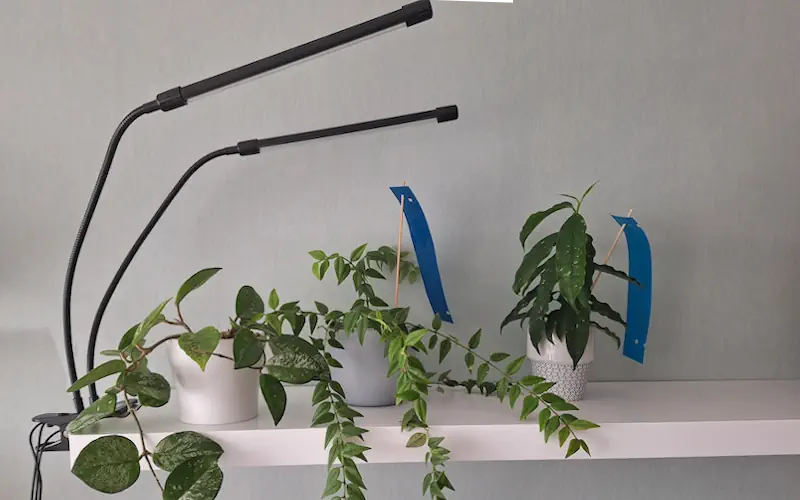
That’s not a marginal claim. Researchers at Purdue University found that LED supplemental lighting does indeed boost plant growth. LED lighting successfully replace natural light for crop growth under controlled conditions — a considerably higher bar than supplementing a houseplant that already gets some window light.
A USDA-reviewed greenhouse study compared seedlings grown without supplemental lighting against LED and high-pressure sodium lighting. Seedlings receiving supplemental light were higher quality than those receiving none. LED and high-pressure sodium fixtures produced comparable finished plants.
Those studies involve commercial crops rather than someone’s pothos on a bookshelf. The biology is still the same.
However, skepticism is reasonable, though. A lot of grow light marketing leans on vague claims — “boosts growth,” “mimics sunlight” — without saying what a plant owner should actually expect to see, or when. That gap is where most of the doubt comes from.
Why Grow Lights Work — The Mechanism, Briefly
Plants use specific light wavelengths — mostly red and blue — to drive photosynthesis, measured as PPFD (photosynthetic photon flux density). A grow light supplies concentrated output in those exact wavelengths, which is why a small grow light often outperforms a much brighter-looking window for actual plant-usable light.
Brightness as your eye perceives it and light as a plant can use it aren’t the same measurement. A window can look bright while supplying a fraction of the PPFD a plant needs, especially a few feet back from the glass or during shorter winter days.
A grow light removes that guesswork — a fixed distance and duration deliver a known, repeatable dose. My article on full-spectrum LED grow lights explains more about how grow lights work.
How Long Before You See Results?
Most houseplants show visible response within 2-4 weeks under a properly positioned grow light — tighter leaf spacing, better color, and steadier new growth. Flowering or variegation-recovery responses take longer, often 6-8 weeks, since those processes draw on more sustained light exposure than basic foliage growth does.
That range assumes the light is actually positioned correctly — right distance, right daily duration. A light that’s too far away or run for too few hours a day stretches that timeline out considerably, sometimes indefinitely.
| Response Type | Typical Timeframe | What to Look For |
|---|---|---|
| Tighter leaf spacing | 2–3 weeks | New growth appears closer together than older growth. |
| Colour return in variegated plants | 3–4 weeks | Brighter, more distinct variegation appears on new leaves. |
| Steadier overall growth rate | 2–4 weeks | New leaves begin appearing on a more consistent schedule. |
| Flowering | 6–8+ weeks | Bud formation begins, most reliably on plants already near maturity. |
| Recovery from stretching | 6–8+ weeks | New growth becomes more compact than the stretched older growth. |
I’ve watched a stretched pothos take almost eight weeks to fully correct its growth pattern under a repositioned light — the new growth compacted quickly, but the older stretched sections never went back.
If you don’t want to bother with grow lights and you have dark corners in your home, these low-light houseplants grow perfectly well without additional lighting.
Signs Your Grow Light Is Actually Working
Tighter spacing between leaves, a return of color in variegated plants, and steady new growth pointed toward the light source — not stretching past it — are the clearest signs a grow light is working. Compact, full growth, not leggy or sparse, is the tell that the plant is getting enough usable light.
| Sign | What It Looks Like | Timeframe to Expect It |
|---|---|---|
| Compact new growth | Shorter distances between leaf nodes than on older growth. | 2–3 weeks |
| Colour returning | Variegated or colourful cultivars show brighter patterning on new leaves. | 3–4 weeks |
| Growth pointed at the light | New leaves and stems orient toward the fixture instead of stretching past it. | 2–3 weeks |
| Consistent new leaf production | Fast growers produce a new leaf every 1–2 weeks, while slower plants respond more gradually. | Ongoing after week 3 |
A plant that’s lush and green but visibly unchanged after a month isn’t necessarily failing — it may just be a slow-growing species. The distinguishing factor is whether new growth, once it appears, looks different from the growth that came before.
Signs Your Grow Light Isn’t Working (or Isn’t Enough)
Leggy growth — long stems with sparse, spaced-out leaves — and a plant still leaning hard toward a window are the clearest signs a grow light isn’t providing enough usable light. This is an under-lighting problem, distinct from light burn, which shows the opposite pattern: damage concentrated near the light, not stretching away from it.

Under-lighting and light burn get confused because both are “the light isn’t right,” but the fix is opposite in each case. Legginess means move the light closer or increase daily hours. Burn means the reverse. Get the distance wrong, and grow lights can burn your houseplants.
The most common under-lighting mistake isn’t a bad light — it’s distance. A light rated for 12-18 inches, mounted at 3 feet because it looked too intense up close, delivers a fraction of its rated output at that range.
Which Plants Show Results Fastest?
Fast-growing, light-hungry plants — pothos, philodendron, snake plant — typically show visible response within 2-3 weeks. Slower-growing or already shade-adapted plants take longer to show a measurable difference, simply because their baseline growth rate is slower regardless of light quality.
Grow lights are useful for specific types of plants and these guides: grow light for snake plant and grow light for hoya cover per-plant setup details and if you always need to use grow lights indoors. A plant that grows slowly under ideal natural light will grow slowly under a grow light too — the light changes the ceiling, not the baseline pace.
Frequently Asked Questions
Do grow lights actually work for houseplants?
Yes. They supply the specific light wavelengths plants use for photosynthesis in a controlled, repeatable dose. That is why they can outperform a window that looks bright but delivers inconsistent usable light.
How do grow lights work?
They emit concentrated red and blue wavelengths — the ranges plants use most efficiently for photosynthesis — measured as PPFD. That targeted output is what makes a modest grow light more effective than ambient room light.
Are grow lights better than a sunny window?
For consistency, often yes. A window’s usable light drops quickly with distance from the glass and changes by season. A grow light delivers a more predictable daily dose, regardless of weather or time of year.
How long does it take to see results from a grow light?
Most houseplants show a visible response within 2–4 weeks. Look for tighter growth, stronger colour, and less stretching. Flowering and full recovery from legginess usually take 6–8 weeks or longer.
Can a grow light fully replace sunlight for a houseplant?
For most common houseplants, yes, provided the fixture is powerful enough and positioned correctly. Plants with very high light demands are harder to support with one small lamp.
Why isn’t my grow light helping my plant?
The most common cause is distance. A light mounted beyond its rated range delivers far less usable light than it appears to. Check the manufacturer’s recommended distance before assuming the fixture itself is ineffective.
If you’re not sure what the right distance and schedule actually is, the step-by-step setup guide walks through height, timers, and how to adjust as your plant grows.
