


As an Amazon Associate I earn from qualifying purchases at no extra cost to you.
The grow lights guide on this site spends 3,600 words making the case for buying one — wattage, PPFD, budget tiers, five tested picks. Fair question if you read all of that: do you actually need it?
For a real subset of common houseplants, the honest answer is no. Ten of them are covered below, all genuinely low-light tolerant, not just marketed that way.
The tradeoff is real too. Less light almost always means slower growth, not no growth — a plant three feet back from a window will still get bigger, just not at the pace of one sitting under 40 watts of full-spectrum LED. If speed matters more than the equipment cost, the grow light guide is still worth a look. If it doesn’t, keep reading.
In this guide
- Quick answer: which of these skip a grow light entirely?
- What counts as “low light” for a houseplant
- 10 houseplants that skip the grow light requirement
- The one plant on this list that doesn’t fully belong
- Which of these actually handles the darkest rooms?
- Still want faster growth? Here’s the alternative
- Frequently asked questions
Quick Answer: Which of These Skip a Grow Light Entirely?
Seven of the ten plants below skip a grow light in any normal room. Cast iron plant and ZZ plant go further and tolerate genuinely dark spaces without one. Peace lily is the outlier — fine on foliage alone, but it won’t reliably bloom without brighter light. The plant-by-plant reasoning follows below.
| Plant | Skips a grow light entirely? | Care difficulty |
|---|---|---|
| Snake plant | Usually, but not the darkest rooms | Very easy |
| ZZ plant | Yes, even in the darkest rooms | Very easy |
| Cast iron plant | Yes | Very easy |
| Pothos | Yes | Easy |
| Dracaena | Yes | Easy |
| Chinese evergreen | Yes | Easy |
| Parlor palm | Yes | Moderate |
| Spider plant | Yes | Easy |
| Philodendron | Yes | Easy |
| Peace lily | For foliage only — not for blooms | Easy |
What Counts as “Low Light” for a Houseplant?
Low light means a spot with no direct sun and modest ambient brightness — a few feet back from a north-facing window, or a windowless bathroom with a bright overhead light running most of the day. It does not mean total darkness.
That distinction matters more than it sounds like it should. Plenty of houseplants marketed as “low light” still need enough ambient brightness to read a book by during the day. A closet with the door shut isn’t low light. It’s no light, and nothing on this list survives that indefinitely.
Most low-light houseplants are understory species by origin — they evolved under a forest canopy, filtering whatever sun made it through leaves overhead. That background is exactly why they tolerate an office desk away from the window or a north-facing bedroom without complaint.
Fluorescent office lighting confuses a lot of people on this point. It looks bright to the human eye, but plants respond to a much narrower band of that light than we perceive, so a well-lit cubicle isn’t automatically equivalent to a well-lit windowsill. The plants below tolerate that gap. They don’t ignore it entirely.
A rough gut check: if there’s enough daylight to read a paperback without switching on a lamp, most of the ten below hold up fine. If the room goes fully dark the moment the sun sets, with no window contribution at all, even these plants start slowing down.
The Biology Behind Shade Tolerance
Not every plant on this list tolerates low light the same way. Three different survival strategies show up across the ten below, and knowing which one a plant uses explains why some hold up in near-darkness while others just get by.
Snake plant uses CAM photosynthesis — a pathway that opens its stomata at night instead of during the day, cutting water loss dramatically. Research on the genus Sansevieria confirms this mechanism, and it’s also why CAM plants grow slowly even in bright light, not just dim rooms.
ZZ plants rely on stored reserves instead. Their thick underground rhizomes hold water and energy, letting the plant coast through weeks of low light on savings rather than daily income. That’s the mechanism behind its reputation for surviving near-total neglect.
A third group — pothos, philodendron, Chinese evergreen, parlor palm, spider plant — are true shade-adapted foliage plants: broader, thinner leaves with more chlorophyll per square inch. Research on leaf traits across climate gradients confirms shade-adapted leaves shift their chlorophyll a:b ratio to capture more of the dim, blue-green light filtering through a canopy.
Peace lily uses the same shade-adapted-foliage strategy, which is why it holds up fine on leaves alone. Flowering needs a real energy surplus beyond basic maintenance — something none of these survival strategies are built to produce without brighter light.
10 Houseplants That Skip the Grow Light Requirement
Ten houseplants routinely skip a grow light requirement in a typical home: snake plant, spider plant, peace lily, pothos, ZZ plant, philodendron, dracaena, cast iron plant, parlor palm, and Chinese evergreen. Each relies on one of the three survival strategies above — slow CAM metabolism, stored reserves, or shade-adapted leaves — to hold up without supplemental light.

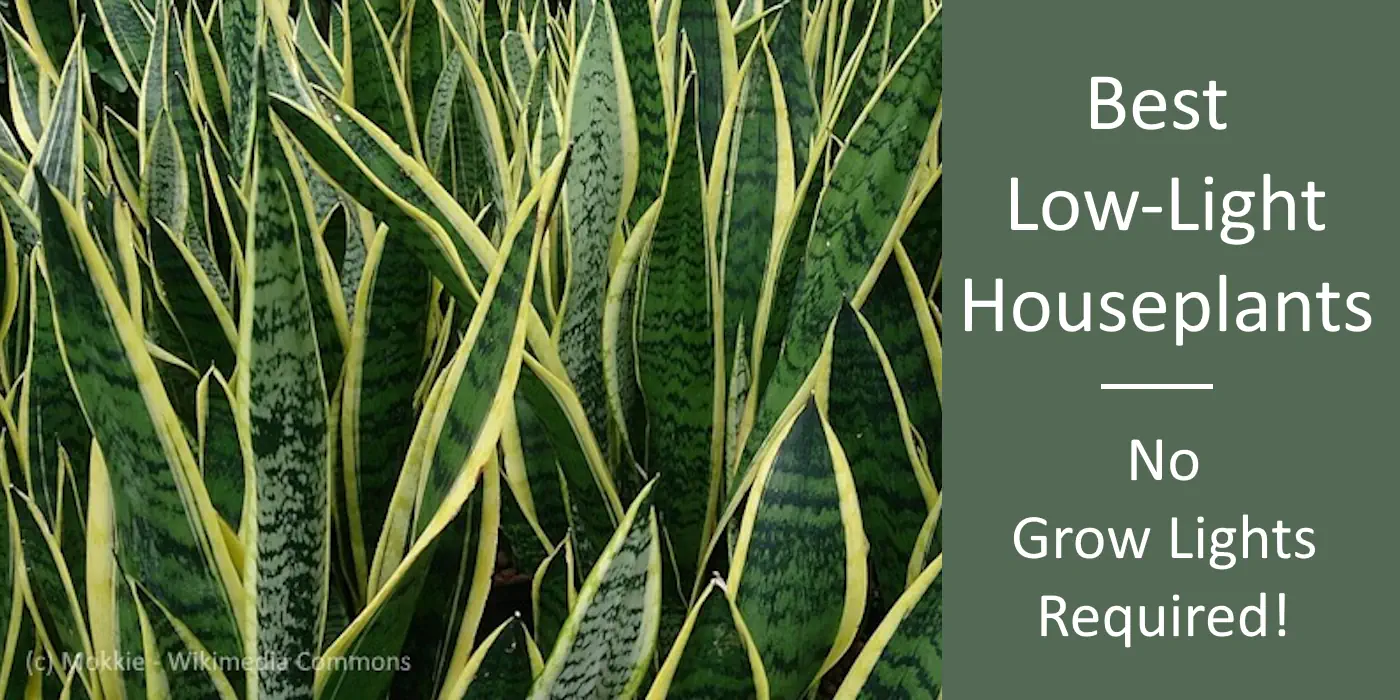
1. Snake Plant
Snake plant tolerates some of the lowest light levels of any common houseplant, and slow watering matters more than light placement for keeping it healthy. It’s one of the few plants on this list where a grow light solves a problem that, for most owners, doesn’t exist. See snake plant flowering and how big snake plants get for care specifics.
That tolerance has a floor, though. A snake plant in a room with genuinely no ambient light — not just dim, but no window contribution at all — will still survive for a while, but it stalls into pale, stretched growth rather than thriving. If that’s the room in question, it’s worth reading whether a snake plant actually needs a grow light before assuming this plant is the fix for every dark corner.
2. Spider Plant
Spider plant handles low-to-moderate indirect light well and is more forgiving of inconsistent watering than most low-light species. The main care note is browning leaf tips, usually from fluoride or chlorine in tap water rather than the light situation. Another case where a grow light addresses a growth-speed preference, not an actual deficiency.
3. Peace Lily
Peace lily survives in low light and will keep its foliage there, but flowering is a different requirement entirely — it needs brighter, indirect light to bloom reliably. Drooping leaves are its clearest “water me” signal of any common houseplant. This is the one plant on the list where skipping a grow light has a real cost, not just a slower one, covered in more detail below.
4. Pothos
Pothos tolerates low light better than almost any trailing houseplant and keeps growing, just more slowly and with smaller leaf spacing between nodes. Trim leggy vines back to a leaf node to keep growth compact rather than stretched. A grow light speeds this plant up considerably, but low light won’t stall it out.
5. ZZ Plant
ZZ plant’s rhizomes store water and energy, which is exactly why it tolerates low light and irregular watering better than almost anything else grown indoors. Overwatering, not underlighting, is what actually kills this plant. It’s one of the two plants on this list built to shrug off a genuinely dim room, not just a merely dim one.
6. Philodendron
Standard philodendron varieties tolerate low, indirect light and keep producing new leaves, though growth slows and leaf size can shrink slightly compared to a brighter spot. Not every philodendron cultivar behaves identically — variegated types generally want more light to hold their patterning, which is really the only case here where a grow light is solving a real problem rather than just speeding things up. See philodendron erubescens for a variety-specific care breakdown.
7. Dracaena
Dracaena tolerates low light and slow growth without much fuss, though brown leaf tips are common if the water source is high in fluoride. Worth a clear distinction here: dracaena is a different plant type from snake plant, even though snake plant is botanically classified as Dracaena trifasciata — the growth habit and care needs diverge enough that treating them as interchangeable is a mistake. A grow light isn’t solving a real gap for this genus in most homes.
8. Cast Iron Plant
Cast iron plant earned its name honestly — it tolerates low light, irregular watering, and general neglect better than nearly any other common houseplant. Growth is slow even under ideal conditions, so a dim corner doesn’t change the plant’s character much. This is arguably the least grow-light-dependent plant on the entire list.
9. Parlor Palm
Parlor palm handles low, indirect light without the browning fronds that many higher-light palms develop in the same conditions. Consistent moisture matters more than brightness here — it doesn’t like drying out completely between waterings. A grow light adds growth speed but isn’t correcting a survival problem.
10. Chinese Evergreen
Chinese evergreen tolerates low light well, though darker-leafed varieties handle dim rooms better than the more heavily variegated cultivars, which want a bit more brightness to maintain their pattern. Growth is naturally slow and compact regardless of light level. Another plant where the grow light decision is about speed and variegation, not survival.

The One Plant on This List That Doesn’t Fully Belong
Peace lily is the exception that proves the rest of this list is honest. It genuinely survives — even holds decent foliage — in low light for years. What it won’t do reliably in that condition is bloom.
Flowering in a peace lily is a brighter-light behavior. Push the plant toward a spot with more indirect daylight and the white spathes show up with some regularity. Leave it in a dim corner and it’s likely to stay green and leafless indefinitely.
That’s a different tradeoff than the other nine plants on this list. Skipping a grow light for a snake plant or a ZZ plant costs you growth speed. Skipping one for a peace lily kept in low light can cost you blooms altogether — not a slower version of the plant, a different version of it.
Worth being direct about this rather than letting it slide into “everything on this list works the same way” territory. It doesn’t.
Which of These Actually Handles the Darkest Rooms?
Snake plant and ZZ plant are the two on this list that hold up even in genuinely dark rooms — a windowless bathroom, a deep interior space, an office cubicle with no window access. Everything else on the list wants at least some indirect daylight reaching it.
Windowless bathroom (bright overhead light, no window)
Snake plant and ZZ plant are the safe bets. Both tolerate the humidity swings a bathroom brings too, which most of the other eight don’t handle as gracefully.
Deep interior room (some ambient light, no direct window access)
Cast iron plant and pothos join the first two here — still no direct sun needed, but slightly more forgiving of a room that gets some daylight bounce rather than none at all.
Office cubicle (fluorescent overhead, occasional daylight from a distant window)
Most of the ten hold up reasonably well in this setting. Philodendron, dracaena, parlor palm, spider plant, and Chinese evergreen all do fine here, though growth will be slower than a home with better natural light.
Peace lily can survive in any of these three settings. It just won’t bloom in the darkest two, which circles back to the caveat above.
One practical note that doesn’t show up in most low-light plant lists: rooms rated “low light” by feel are rarely rated consistently between one house and the next.
A north-facing window in a home with white walls and few obstructions behaves differently than the same orientation in a room with heavy curtains or a building shadow outside.
If a snake plant or ZZ plant starts stretching toward a light source or dropping leaves faster than expected, the room is probably dimmer than assumed — move the pot before assuming the plant is failing for some other reason.
Still Want Faster Growth? Here’s the Alternative
For readers who want faster growth, fuller foliage, or the option to add a higher-light plant to the mix, a grow light closes that gap in a way low light placement alone can’t. None of the ten plants above need one to survive — that’s the whole point of this list — but all of them grow faster under one.
That’s the case the grow lights guide makes in more detail: wattage vs. PPFD by plant type, realistic budget tiers, and five tested picks across price points. Worth reading before buying anything, since the wrong wattage for the plant is the most common mistake first-time buyers make.
There’s also a middle option worth naming: a grow light doesn’t have to cover the whole plant collection. Adding one clip light over a single higher-light plant — a fiddle leaf fig, a hoya pushed toward blooming, a variegated philodendron trying to hold its pattern — while leaving the ten plants above on ambient room light is a reasonable way to split the decision instead of treating it as all-or-nothing.
Just watch the distance and hours if you go this route — a light dialed in for a hoya or fiddle leaf fig can still scorch a nearby pothos or calathea if it’s mounted too close. Grow lights can burn houseplants covers which plants are most at risk and how to avoid it.
And if you’re weighing whether the extra equipment is worth it at all, the evidence for whether grow lights actually work is worth reading before you buy anything.
Frequently Asked Questions
Do low-light plants need any sun at all?
Most need indirect ambient brightness rather than direct sun. A spot near a window, without strong rays hitting the leaves, usually works well.
True low-light plants such as snake plants and ZZ plants tolerate very dim rooms. “Low light” still does not mean complete darkness.
Can these plants grow in artificial light only?
Yes. A bright overhead light or lamp left on for several hours can support the plants on this list without a dedicated grow light.
Growth will usually be slower than under natural daylight or a full-spectrum LED. They survive. They do not suddenly turn into overachievers.
Why is my low-light plant not growing?
The most common cause is overwatering rather than underlighting. ZZ plants, cast iron plants, and dracaenas often suffer from wet soil before low light becomes the main problem.
Check the soil first. If it stays damp for days, reduce watering before moving the plant or buying another light.
Which low-light plant is hardest to kill?
Cast iron plants and ZZ plants are usually the most forgiving choices. Both tolerate irregular watering, low light, and inconsistent care better than most houseplants.
Do low-light plants need less water too?
Not automatically. Light and water needs are separate, even though dim conditions usually slow how quickly soil dries.
Peace lilies prefer steadier moisture. Snake plants and ZZ plants should dry much more thoroughly between waterings.
Is a low-light plant a good option for a windowless office?
Snake plants and ZZ plants are the strongest choices for a windowless office. The other plants can survive under strong fluorescent or LED room lighting, but most perform better with occasional natural daylight.
