


As an Amazon Associate I earn from qualifying purchases at no extra cost to you.
If you’re shopping for grow lights for snake plants, the honest answer is that most snake plants don’t need one to survive. They’re one of the few houseplants built to hold up in genuinely low light, which is exactly why so many end up in hallways and offices with no natural light at all.
That tolerance is also why people second-guess themselves. A snake plant that isn’t dying doesn’t necessarily mean it’s growing well — slow, pale, stretched growth is easy to write off as “just what this plant does” instead of a light problem worth fixing.
A grow light won’t rescue a snake plant that’s actually dying — that’s almost always a root or watering issue. But for a plant that’s merely coasting in low light, the right low-wattage light speeds things up without the cost or hassle of a serious grow light setup.
In this guide
Do Snake Plants Actually Need a Grow Light?
Most snake plants don’t need a full-spectrum grow light to survive — they’re one of the few houseplants engineered by evolution to tolerate low light long-term. But surviving and thriving aren’t the same thing. A grow light won’t save a dying snake plant, but it will speed up growth and stop the pale, stretched look that comes from too little light.
Snake plants (Sansevieria, now technically reclassified under Dracaena) evolved in the dry, shaded understories of West African forests, often under a full tree canopy. That background is why they store water in thick leaves and cope fine with light levels that would stress out a fern or a calathea.
Source: New York Botanical Garden — Snake Plant LibGuide
Low light tolerance gets misread as “no light needed.” It isn’t the same thing. A snake plant in a genuinely dark corner will hang on for months, sometimes years, without putting out much new growth at all. It’s not thriving — it’s idling.

This is where a lot of grow-light advice overcorrects. Most guides treat a grow light as close to mandatory for any snake plant that isn’t in a bright room. In practice, a healthy snake plant getting a few hours of indirect daylight a day is usually fine without one. The light matters more once natural light drops to near zero.
Signs Your Snake Plant Would Benefit From a Grow Light
Three signals mean a grow light is worth adding: new leaves growing thin and pale instead of firm and green, growth that’s stalled for months rather than just slowed, and leaves leaning or stretching toward the nearest window.
None of these are emergencies. They’re the plant telling you it wants more consistent light, not warning signs of a bigger problem.
- Pale or thin new leaves. Healthy snake plant leaves grow firm and deep green. New growth that comes in noticeably paler or floppier than the older leaves is a light-availability issue, not usually a watering one.
- Growth that’s stopped, not just slowed. Snake plants are slow growers by nature — one or two new leaves over several months is normal. No visible growth at all for six months or more, in a plant that’s otherwise healthy, points to insufficient light.
- Leaning or stretching. A snake plant reaching sideways toward a window is doing what any plant does when light is uneven — chasing the brightest source available.
I’ve seen this most often in corner plants that get a couple of hours of weak morning light and nothing else. They don’t look sick. They just look stuck.
If a snake plant is also mushy at the base, yellowing across whole leaves, or has a rotten smell, that’s a root or watering problem — a grow light won’t touch it. My Complete Snake Plant Guide helps troubleshoot all types of grow problems incase low light is the culprit for poor growth.
How Far Should a Grow Light Be From a Snake Plant?
Keep a low-wattage clip or stake grow light 12–18 inches above a snake plant’s leaves. Snake plants tolerate more distance and lower intensity than a flowering or fruiting plant would need, so there’s no reason to run the light closer or brighter — that risks scorching without meaningfully speeding up growth.
If you’re troubleshooting scorching on any houseplant, not just a snake plant, the full symptom and fix breakdown is here.
Grow light advice online often borrows PPFD numbers (a measure of light intensity) built for plants that are actively flowering or fruiting, where light output really does need to be dialed in closely. Snake plants aren’t in that category. There’s no meaningful reason to chase precise intensity numbers for a plant this tolerant — get the light in the 12–18 inch range and move on.
Source: University of Minnesota Extension — Lighting Indoor Plants
Tall varieties — Sansevieria cylindrica, or a mature Laurentii pushing three feet or more — change the math slightly. A small clip light mounted at the pot won’t reach the top leaves evenly. That’s a placement problem, not a wattage problem, and it’s the main reason to look at a taller, adjustable stand light instead of a clip.
How Long to Grow Lights Run on Snake Plants Each Day
Run a grow light on a snake plant for 8–10 hours a day, timed to overlap with whatever natural light the room already gets. That’s shorter than the 12–14 hours some grow-light guides recommend for higher-light plants — snake plants aren’t chasing flowering or fruiting output, so the extra hours don’t add much.
A timer is the practical fix here, not a habit of remembering to flip a switch twice a day. All three lights recommended below include a built-in timer function, which matters more for consistency than for any specific hour count. See how to set up grow lights for indoor plants to get your setup just right.
Running a light 24 hours a day doesn’t speed things up further — plants use a dark period for other metabolic processes, and skipping it isn’t the shortcut it looks like. 8–10 hours, same time each day, is enough.
The Grow Lights Worth Buying for a Snake Plant
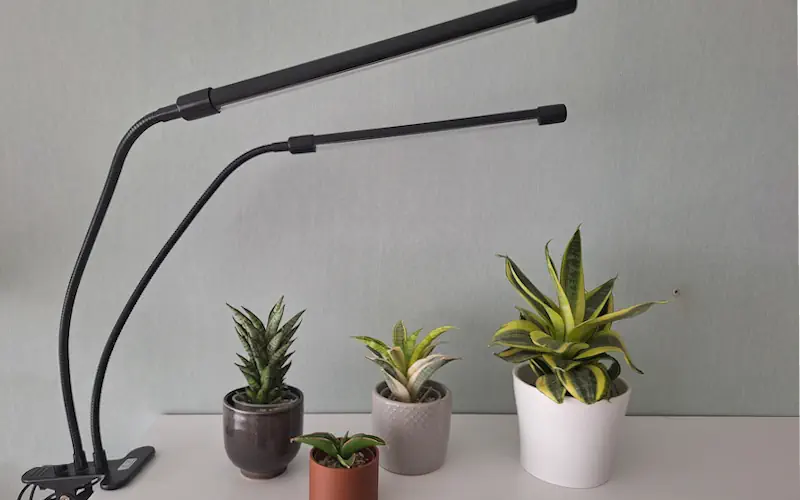
For a single, average-height snake plant, a small clip-on LED grow light is enough — there’s no need for a large stand or a high-wattage panel. The exception is a genuinely tall variety, where a clip light’s downward angle stops reaching the upper leaves evenly. The article How Big Do Snake Plants Get covers which varieties actually get tall enough for this to matter — a standard Laurentii under three feet rarely needs anything more than the clip light below.
GooingTop LED Clip Grow Light
Best for: a single snake plant on a desk, shelf, or windowsill.
A 6000K full-spectrum clip light with a flexible gooseneck and a built-in timer (4/8/12-hour settings). Draws about 10 watts — roughly the cost of a 50-watt halogen bulb, and an estimated $2 a month in electricity running 12 hours a day. This is the low-intensity setup a snake plant actually needs; there’s no reason to buy anything larger for one plant.
GooingTop LED Clip Grow Light
Best for: a single snake plant on a desk, shelf, or windowsill.
A 6000K full-spectrum clip light with a flexible gooseneck and a built-in timer (4/8/12-hour settings). Draws about 10 watts — roughly the cost of a 50-watt halogen bulb, and an estimated $2 a month in electricity running 12 hours a day. This is the low-intensity setup a snake plant actually needs; there’s no reason to buy anything larger for one plant.
GLOWRIUM 36W Vertical Grow Light
Best for: a genuinely tall snake plant — a mature Sansevieria cylindrica or a Laurentii pushing past 4–5 feet — where an overhead clip or stand light no longer lights the lower leaves evenly.
This is a side-lighting design, not an overhead one: a 120° beam angle throws light along the height of the plant rather than down onto the top of it, which is the actual problem with tall, columnar snake plants under a standard clip light.
36 watts is more output than a small or average snake plant needs, but for a floor-standing specimen, that’s the point — it’s covering more plant, not more intensity per leaf. You can find out how big snake plants get and the the height benchmarks for several popular tall varieties.
Frequently Asked Questions
Can a snake plant survive with no light at all?
No. Low-light tolerance is not the same as no light. A snake plant kept somewhere with genuinely zero daylight and no supplemental light will decline slowly, even if it takes months to become obvious.
Will a grow light make my snake plant grow faster?
Yes, moderately. Expect steadier, greener new growth rather than a dramatic jump in size. Snake plants are slow growers by nature, even under better light.
Can I leave a grow light on all day?
No. Leaving it on continuously does not keep speeding growth and removes the dark period the plant uses for other processes. A timer set to 8–10 hours is enough for most snake plants.
Does a snake plant need a special light color or spectrum?
No. A standard full-spectrum LED is enough. The stronger spectrum lights marketed for flowering plants are unnecessary for snake plants.
Is a grow light better than moving the plant near a window?
Depends on the window. Best low-light houseplants covers that comparison in more depth — for a snake plant already stuck in a dark spot, a small clip light is usually the simpler fix.
