


As an Amazon Associate I earn from qualifying purchases at no extra cost to you.
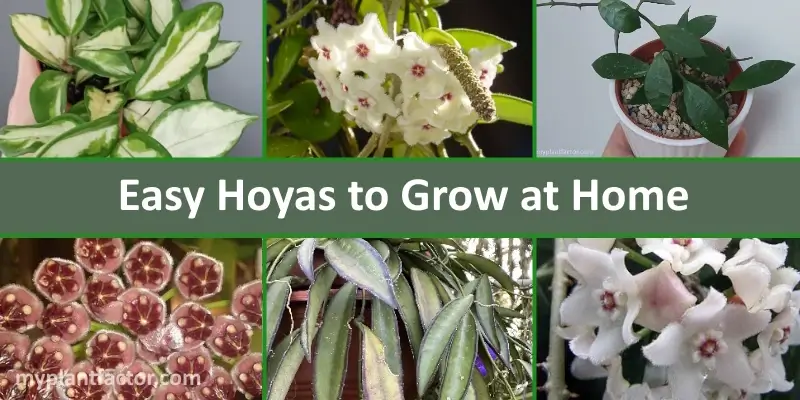
Are you looking to buy your first Hoya plant and want it to thive? The good news, if you’re starting out on your Hoya collection, is that many Hoya varieties are easy to grow indoors. The best types are are usually forgiving, adaptable indoors, and less likely to sulk over one bad watering decision. Pretty matters, sure. Easy matters more.
The best hoya varieties for beginners are Hoya carnosa, Hoya pubicalyx, Hoya obovata, Hoya bella, and Hoya cumingiana. These types are easier to grow indoors because they handle normal household conditions better, forgive some care mistakes, and feel more rewarding early on.
For a complete list of 30+ Hoya plants (wax plants, my Comprehensive Guide to Types of Hoyas has information about identifying wax plants, how to care for them, and some rare types for serious collectors.
This page is for choosing hoya varieties if you’re a beginner, not identifying them.
Table of Contents
- How Do You Choose the Best Hoya for Beginners?
- Quick Picks: Best Beginner Hoyas by Situation
- Best Hoya for Small Apartments
- Best Hoya for Low-Light Rooms
- Best Hoya for Forgetful Waterers
- Best Hoya for Hanging Baskets and Shelves
- Best Hoya if You Want Flowers Sooner
- Best Hoya if You Want Fast Growth
- Best Hoya for Busy Plant Owners
- Which Hoyas Beginners Should Avoid at First
- Beginner Hoya Care Rules That Matter More Than the Variety
- Why These Hoya Varieties Are Easy to Grow
- Hoya Varieties for Beginners: FAQs
How Do You Choose the Best Hoya for Beginners?
Most beginners pick a hoya based on how it looks in a photo. That’s understandable, but it tends to lead to frustration. You end up with a plant that’s technically beautiful and practically wrong for where you live.
A few questions narrow it down fast:
- How much light does your space actually get?
- Do you want something trailing, compact, or upright?
- Are you a consistent waterer or do you go stretches without thinking about it?
- Do you want flowers, or do you just want the plant to look healthy?
The answers matter more than the species name.
What makes a hoya easy for beginners
Three things: forgiving watering habits, tolerance for average indoor light, and predictable growth. A plant that sends distress signals slowly gives you time to course-correct. A plant that collapses the moment you forget to water once does not.
Most beginner-friendly hoyas store moisture in their thick leaves. That’s not an accident — it’s what makes them forgiving. When in doubt, choose the thicker-leaved variety.
Why space and growth habit matter more than rarity
A fast-growing trailing hoya in a small shelf space will become a problem within a season. A compact upright hoya in the same space will stay manageable for years.
Growth habit is one of the most overlooked factors. It’s not just about how big a plant gets — it’s about how it gets there and whether that works in your specific setup.
The mistake beginners make when choosing by looks alone
Rare and variegated hoyas look stunning in plant shop photos. They’re also slower growers, more sensitive to inconsistent light, and less forgiving overall. Starting with something like a Hoya kerrii heart or a heavily variegated cultivar is setting yourself up for a slow, quiet failure.
Start with a plant that’s easy to keep alive. Build confidence first. The rare ones will still be there.
Quick Picks: Best Beginner Hoyas by Situation
| Situation | Best Hoya | Why it works | Watch out for | Best next step |
|---|---|---|---|---|
| Small apartment | Hoya cumingiana | Compact, upright, flowers easily | Can stall in too-low light | Keep near a bright window |
| Low-light room | Hoya carnosa | Handles lower light better than most | Will grow slowly without good light | Supplement with a grow light if needed |
| Forgetful waterer | Hoya obovata | Very thick leaves store water well | Root rot if pot stays wet | Always use well-draining mix |
| Hanging shelf | Hoya bella | Graceful trailing habit, easy bloomer | Dislikes being moved once settled | Find a permanent spot and leave it |
| Want flowers fast | Hoya lacunosa | Blooms readily indoors, fragrant | Needs consistent light to keep flowering | Bright indirect light, avoid moving it |
| Fast growth | Hoya pubicalyx | One of the quickest-growing common hoyas | Gets leggy in low light | Give it a bright spot and it takes off |
| Busy or irregular schedule | Hoya carnosa | Drought-tolerant, tolerates neglect | Overwatering is the main risk | Water less than you think you need to |
Not sure which to pick? Start with Carnosa or Pubicalyx—they’re the least fussy of all the Hoya varieties.
Best Hoya for Small Apartments
The best hoya for small apartments is Hoya cumingiana — it stays compact and upright without aggressive vining, and flowers more readily than most beginner species. For a more widely available alternative, Hoya mathilde is a manageable hybrid that stays contained in limited space.

Why compact growth wins in tight spaces
A plant that stays within a predictable footprint is easier to manage. You’re not constantly deciding where to route new vines or dealing with overgrowth onto nearby shelves. In smaller spaces, compact growers stay attractive longer without much effort.
Best pick: Hoya cumingiana
Hoya cumingiana tends to stay relatively upright and compact. It doesn’t trail aggressively. It produces clusters of small yellow-orange flowers more readily than a lot of other species, which makes it rewarding for beginners who want to see results. Light requirements are reasonable — bright indirect light works well.
It’s not the most widely available hoya, but it’s worth looking for.
Alternate pick: Hoya mathilde
Hoya mathilde is a hybrid that stays manageable in size while producing good growth. The leaves are speckled, which adds visual interest. It handles average indoor conditions well and doesn’t demand anything unusual. A reasonable second choice if cumingiana isn’t available locally.
Best Hoya for Low-Light Rooms
The best hoya for low-light rooms is Hoya carnosa. It tolerates lower light levels longer than most hoya species without rapid decline. In genuine low light — no direct window access, overhead lighting only — growth will be slow and flowering unlikely, but the plant stays stable.

What low light means for a hoya
Hoyas are subtropical plants. In their natural habitat they grow in filtered light under forest canopy — but that’s still substantially more light than a dim room in most homes. “Tolerates lower light” means the plant won’t die immediately. It doesn’t mean the plant will thrive or bloom.
If your room genuinely has low light, managing expectations is part of the process.
Best pick: Hoya carnosa
Hoya carnosa is probably the most adaptable of the common hoyas. It handles lower light better than most and doesn’t punish you immediately for suboptimal conditions. Growth will be slow in low light, and flowering is unlikely without a brighter spot, but the plant will stay alive and reasonably healthy.
It’s also widely available and inexpensive, which makes it a low-stakes first purchase.
Alternate pick: Hoya pubicalyx
Hoya pubicalyx is another relatively adaptable species that can tolerate lower light conditions. It grows faster than carnosa given decent light, so it’s a good option if your space is dim but you want something that still puts on visible growth. The dark green leaves with silver flecks hold up well even when conditions aren’t ideal.
Best Hoya for Forgetful Waterers
The best hoya for forgetful waterers is Hoya obovata. Its thick, succulent-like leaves store enough moisture to handle 2–3 weeks between waterings without visible stress. Hoya carnosa is a reliable second choice — also drought-tolerant, with a clear early warning signal (slight leaf wrinkling) before any real damage sets in.

Which hoyas forgive dry spells better
The rule of thumb: if the leaf is noticeably thick and waxy, the plant can handle irregular watering. If the leaf is thin and papery, it needs more consistent moisture. Most beginner-friendly hoyas fall into the thick-leaf category, which is one reason they’re recommended for beginners in the first place.
Soil matters too. A chunky, well-draining mix dries out at an appropriate pace. A dense or moisture-retaining mix sits wet far too long, which is a bigger problem than forgetting to water.
Best pick: Hoya carnosa
Hoya carnosa has thick, waxy leaves and handles periods of drought well. The most common way to kill it is overwatering, not underwatering. If you tend to forget about your plants for a week or two at a time, carnosa is likely to be fine. It will tell you it’s thirsty by developing slightly wrinkled leaves — a clear, unhurried signal.
Alternate pick: Hoya obovata
Hoya obovata takes drought tolerance a step further. The leaves are notably thick and succulent-like in texture. It genuinely stores moisture well. I’ve seen obovata sit dry for three weeks in summer without showing any distress. Not a recommendation to test that, but the buffer is real. It’s also a faster grower than carnosa in good conditions, which makes it satisfying to keep.
Best Hoya for Hanging Baskets and Shelves
The best hoya for hanging baskets is Hoya bella. It has a naturally pendulous, contained trailing habit — no aggressive vining — and blooms readily once settled in a fixed position. Hoya lacunosa is a close second: finer vines, small leaves, and reliable fragrant flowers in a bright indoor spot.

Trailing hoyas look good on shelves and in hanging planters, but they don’t all trail the same way. Some vine quickly and need regular trimming. Others trail gracefully and stay relatively tidy.
Why trailing growth works better here
Compact upright growers don’t fill a hanging basket well. They tend to look sparse and awkward when suspended. Trailing varieties naturally cascade and fill the space. A shelf with a long trailing hoya hanging over the edge looks intentional. The same shelf with an upright compact hoya in a hanging pot looks like a mistake.
Best pick: Hoya bella
Hoya bella (also known as Hoya lanceolata subsp. bella) has a naturally pendulous trailing habit that suits hanging planters well. It’s not an aggressive grower, which means it stays contained. It also blooms readily once established — small clusters of white star-shaped flowers with a pink-purple center. The fragrance is noticeable but not overpowering.
One thing to know: Hoya bella doesn’t like being moved once it’s settled and flowering. Find a spot and leave it there.
Alternate pick: Hoya lacunosa
Hoya lacunosa trails well and stays manageable. It’s a reliable bloomer and the flowers have a distinct sweet fragrance, especially in the evening. Leaves are small and the vines are finer than carnosa or pubicalyx, which gives it a slightly more delicate look. A solid choice for a hanging position in a bright room.
Best Hoya if You Want Flowers Sooner
The hoyas most likely to bloom within the first year indoors are Hoya bella and Hoya lacunosa. Both flower without needing to be severely pot-bound or stressed. The key condition is consistent bright indirect light in a fixed location — moving the plant after buds form causes bud drop.
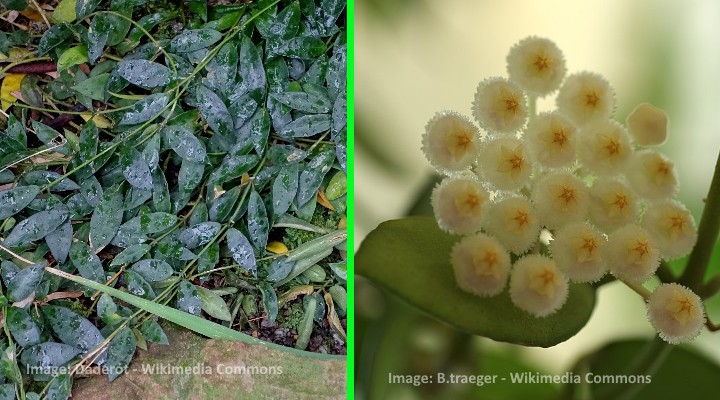
Hoyas can take a while to establish before they bloom. But some species flower more readily than others, especially indoors. If blooming is a priority, the variety choice matters.
Which hoyas bloom more willingly indoors
A few factors drive flowering: consistent bright indirect light, a slightly pot-bound root system, and stable conditions (hoyas often resent being moved when they’re about to bloom). Stress — in the form of a brief dry spell or a slightly cooler night temperature — can also trigger flowering in some species.
Avoid moving a hoya that’s forming buds. Bud drop from relocation is common and genuinely frustrating.
Best pick: Hoya bella
Hoya bella blooms more readily indoors than many other species. Once it’s in a stable position with good light, it doesn’t take long to start producing flower clusters. The blooms are attractive and fragrant, which makes the wait worthwhile. Good choice if you want to actually see a hoya flower within the first year.
Alternate pick: Hoya lacunosa
Hoya lacunosa is another reliable bloomer. Some growers report it flowering multiple times a year once established. The flowers are smaller than carnosa blooms but the fragrance is stronger. If you want regular flowering in an indoor setting, lacunosa is one of the more consistent performers.
Best Hoya if You Want Fast Growth
The fastest-growing common hoya is Hoya pubicalyx. In bright indirect light with regular watering through the growing season, it produces noticeable vine extension within weeks. Hoya australis and Hoya carnosa grow at a moderate pace and are reliable alternatives if pubicalyx isn’t available locally.

Some hoyas grow slowly. Very slowly. If you want to see visible progress within a growing season, variety selection matters.
Why quick growers feel more rewarding for beginners
Slow growers are harder to stick with when you’re starting out. You water, wait, water again, and see almost nothing happen. A fast grower gives you feedback. New leaves appear. Vines extend. You can see the plant responding to what you’re doing.
That’s not a trivial thing. Visible progress keeps you interested.
Best pick: Hoya pubicalyx
Hoya pubicalyx is one of the faster-growing common hoyas. Given decent light and regular watering during the growing season, it puts on noticeable growth. The vines can get long quickly, which is useful if you want a plant that fills space. It also adapts to a reasonable range of indoor conditions.
In low light it will get leggy — long vines with wide spacing between leaves. Bright indirect light is where it performs best.
Alternate pick: Hoya australis or Hoya carnosa
Both Hoya australis and Hoya carnosa grow at a decent pace compared to some of the slower species. Australis in particular tends to vine actively in good conditions. It’s less widely available than carnosa but worth looking for if fast growth is your priority.
Best Hoya for Busy Plant Owners
The best hoya for busy plant owners is Hoya carnosa. It tolerates drought, irregular fertilising, and a range of light conditions without significant decline. Hoya obovata is an equally practical choice — marginally better drought tolerance, slightly faster growth, and no greater sensitivity to inconsistent care.

This is really about the combination of drought tolerance, low sensitivity to inconsistent conditions, and not needing much hands-on attention.
Lower-fuss hoyas that handle normal life
Normal life means forgetting to water for two weeks, going on holiday, irregular fertilising, and occasional draughts from open windows. The plants that handle this without sulking are the ones worth recommending to people who don’t have a plant-focused routine.
Hoyas are generally on the easier end of the indoor plant spectrum. But even within the genus, some are more forgiving than others.
Best pick: Hoya carnosa
Hoya carnosa remains the most practical all-around choice for busy owners. It tolerates drought. It tolerates irregular fertilising. It handles a range of light conditions. It doesn’t drop leaves at the first sign of disruption. It’s not glamorous, but it consistently survives without needing much from you.
It also lives for a very long time. There’s a reason older homes often have a carnosa that’s been growing in the same pot for decades.
Alternate pick: Hoya obovata
Hoya obovata is a close second for busy growers. Its drought tolerance is excellent and it’s not particularly sensitive to temperature swings or inconsistent light. If you want something with slightly more visual interest than carnosa — the round leaves with silver speckles are distinctive — obovata is a reliable option.
Which Hoyas Beginners Should Avoid at First
Beginners should avoid Hoya kerrii singles (a leaf without a node cannot grow into a full plant), Hoya linearis (thin leaves need consistently moist soil), Hoya wayetii and Hoya shepherdii (narrow margin for watering error), and rare variegated cultivars (expensive, slow-growing, and high-stakes to lose as a first plant).
These plants aren’t inherently difficult. But they reward experience, consistency, and patience — things that are harder to offer when you’re still figuring out the basics.
Slow growers that test patience
Hoya kerrii (the heart-leaf hoya) is frequently sold as a novelty single-leaf cutting. That single leaf will not grow into a full plant — it doesn’t have a node. It sits there, looking unchanged, for years. Even the full-plant version of kerrii is a famously slow grower. Not ideal as a first hoya if you want to see progress.
Hoya linearis is another slow grower with thin, thread-like leaves that require more consistent moisture than the thick-leaved varieties. It’s beautiful, but it demands more attention than a beginner typically wants to give.
Fussy hoyas that punish watering mistakes
Hoya wayetii and Hoya shepherdii both have thin, elongated leaves that are more sensitive to overwatering and inconsistent moisture. They’re not impossible to grow, but the margin for error is smaller than with carnosa or obovata.
Rare collector hoyas that make bad first plants
Hoyas like Hoya undulata, Hoya mirabilis, and various highly variegated cultivars are expensive, slow, and particular about conditions. They’re not good first purchases. The cost of losing one makes the learning curve stressful. Get comfortable with a common species first.
Beginner Hoya Care Rules That Matter More Than the Variety
Most beginner hoya failures come from overwatering and dense potting mix — not the wrong variety. The three highest-impact rules: use a chunky, fast-draining potting mix; water only when the mix has dried significantly; and place the plant in bright indirect light near an east- or west-facing window.
The honest truth is that most beginner failures with hoyas come down to a handful of care mistakes — not the wrong variety choice. Getting these right matters more than which plant you buy.
Many Hoyas are remarkably easy to care for, even for plant novices. But that doesn’t mean they can survive on neglect. This guide to Hoya Plant Care discusses all you need to know about watering, soil conditions, light, and fertilizer. But here are a few tips to get you started
Light
Hoyas need bright indirect light to thrive. A spot near an east- or west-facing window is usually ideal. A north-facing window will keep most hoyas alive but not growing well. Direct harsh afternoon sun can scorch the leaves of some species.
If your space is genuinely dim, a simple grow light makes a measurable difference. It doesn’t need to be expensive.
Watering
This is where most beginners go wrong. Hoyas do not like sitting in wet soil. They’re epiphytic in nature — in the wild their roots get moisture and then dry out fairly quickly. Replicating that cycle matters.
Water thoroughly, then let the mix dry out significantly before watering again. In winter, water even less. The exact frequency depends on your pot size, mix, and environment — checking the soil is more reliable than following a schedule.
Root rot from overwatering is the most common way hoyas die. It’s also largely preventable.
Potting mix
A standard indoor potting mix is often too dense and moisture-retentive for hoyas. Adding perlite, bark, or coco coir improves drainage and aeration. A mix that dries out at a reasonable pace does more for long-term plant health than most other interventions.
Fertilising
During the growing season (spring and summer), a balanced liquid fertiliser applied roughly once a month is enough. Hoyas don’t need heavy feeding. In autumn and winter, ease off or stop entirely.
One more thing
Don’t remove the spent flower stalks (peduncles). Hoyas rebloom from the same stalks. Cutting them off means waiting much longer for the next round of flowers.
Why These Hoya Varieties Are Easy to Grow
Easy hoya varieties tend to share a few traits—they’re flexible, forgiving, and don’t need perfect conditions to look good. If you’ve struggled with houseplants before, these are the ones that usually bounce back.
- They handle missed watering
Most beginner-friendly hoyas store water in their thick, waxy leaves. That means they’re far more forgiving if you forget to water for a few days. - They adapt to typical indoor light
These varieties grow well in bright, indirect light but don’t collapse if conditions aren’t ideal. Some can even tolerate slightly lower light without major issues. - They grow steadily without constant attention
You don’t need to micromanage them. Once established, they put out new growth consistently without needing frequent adjustments. - They’re less prone to common issues
Compared to fussier plants, these hoyas are less likely to suffer from pests or sudden decline when conditions change slightly. - They recover well from small mistakes
A bit too much water, a missed feeding, or moving them around occasionally won’t usually set them back long-term.
If you’re choosing your first hoya—or just want something that doesn’t need constant checking—these are the traits that make all the difference.
Which Beginner Hoya Fits You Best?
Use this quick match guide if you want the fastest answer. The differences between these Hoyas are real, but they are not huge. Getting the light and watering right will usually matter more than the exact variety you choose.
- Low light, low maintenance, no fuss: Hoya carnosa
- Small space, want flowers: Hoya cumingiana
- Forgetful waterer: Hoya obovata
- Hanging basket or shelf: Hoya bella
- Want fast growth: Hoya pubicalyx
- Want regular fragrant flowers: Hoya lacunosa
Any of these can give you a solid first experience with Hoyas. Pick the one that fits your room and habits best, then keep the setup simple.
Hoya Varieties for Beginners: FAQs
How long does it take for a hoya to bloom for the first time? +
Most hoyas take 1–2 years to bloom for the first time indoors. Fast bloomers like Hoya bella and Hoya lacunosa can flower within the first year if given consistent bright indirect light in a stable position. Slow bloomers like Hoya kerrii may take 3–5 years—or never bloom indoors at all.
Are hoyas toxic to cats and dogs? +
Hoyas are generally considered non-toxic to cats and dogs. They do not appear on the ASPCA toxic plant list. The waxy leaves can cause mild digestive upset if eaten in large amounts, so it is still worth keeping them out of reach of pets that chew plants.
Can hoyas grow in a bathroom? +
Hoyas can grow well in a bathroom if there is a window with adequate light. The added humidity from showers usually suits them. A bathroom with no window, or only a small frosted window, will not provide enough light for healthy long-term growth.
Do hoyas need a trellis or support? +
Trailing and vining hoyas benefit from a trellis, hoop, or other support, but they do not strictly need one. Varieties like Hoya pubicalyx and Hoya carnosa can trail naturally, while compact upright types like Hoya cumingiana usually stay self-supporting.
Why is my hoya not growing? +
The most common causes are insufficient light, overwatering, or normal winter slowdown. Hoyas in low light often survive without producing much new growth. In autumn and winter, reduced growth is normal and does not usually mean something is wrong.
Can I grow a hoya from a cutting? +
Yes. Hoyas propagate well from stem cuttings. Take a cutting with at least one node, place it in water or moist perlite, and keep it in bright indirect light. Most common hoyas root within 3–6 weeks at normal room temperature.
Do hoyas need to be misted? +
Misting is not necessary for most hoyas. Their thick leaves do not benefit much from surface misting, and extra moisture on the foliage can leave marks or encourage fungal issues in stale rooms. A humidifier or pebble tray works better if your home is very dry.
What temperature do hoyas need indoors? +
Most hoyas do well between 15°C and 29°C (60°F–85°F), which fits normal household temperatures. Avoid cold draughts, air conditioning vents, or winter windows that drop too low overnight. Cold glass can damage leaves that rest against it.
Should I remove hoya flower stalks after blooming? +
No. Leave hoya flower stalks, or peduncles, in place after blooming. Hoyas often rebloom from the same stalk, so removing it can delay future flowering. Even when the flowers have dropped, the bare stalk should stay on the plant.
What is the easiest hoya to grow indoors? +
Hoya carnosa is widely considered the easiest hoya to grow indoors. It tolerates lower light, irregular watering, and normal beginner inconsistency better than most other species. It is also common, affordable, and easy to replace if something goes wrong.
